2025 AMC 10A Problem 13
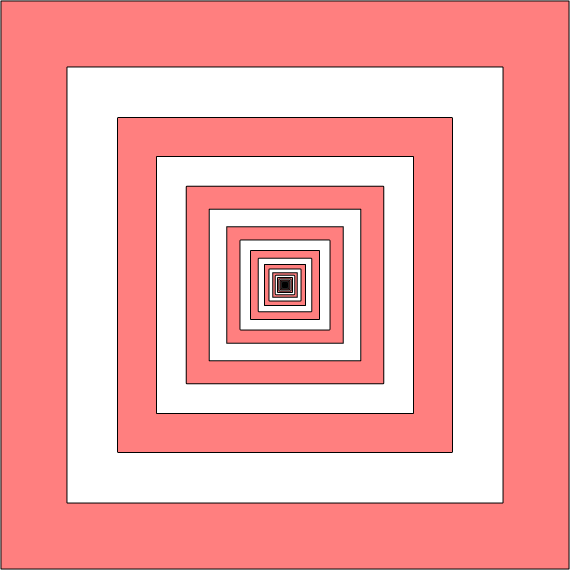
In the figure below, the outside square contains infinitely many squares, each of them with the same center and sides parallel to the outside square. The ratio of the side length of a square to the side length of the next inner square is , where The spaces between squares are alternately shaded as shown in the figure (which is not necessarily drawn to scale).
The area of the shaded portion of the figure is of the area of the original square. What is ?
Show solution without answering
Key insight
Each shaded ring is a shrunken copy of the one two rings further out, so the shaded areas add up to 1/(1 + k squared).
Solution
The picture goes on forever, so the rings cannot be added one at a time. The plan is to find a pattern in their areas and add them all at once.
- Make the outer square have side , so its area is . Then " of the original square" just means the shaded area is .
- Each square is times as wide as the one around it. So the sides are and the areas (side times side) are
- A ring is the space between two neighboring squares, so its area is the bigger square minus the smaller one:
| Ring | Color | Area |
|---|---|---|
| 1st (outermost) | shaded | |
| 2nd | white | |
| 3rd | shaded | |
| 5th | shaded |
4. Look at the shaded rows. Each shaded ring is the shaded ring two steps further out, shrunk; its area is times as big. So the shaded total is
5. This is an infinite geometric series: first term , and each term is times the one before. Since is between and , the sum is "first term divided by ( minus the multiplier)":
6. The bottom is a difference of squares: . Cancel the from top and bottom:
7. Now use . Flip both sides: , so and (it must be positive).
Check: with , and .
The answer is .
Why this works
When a figure repeats forever by shrinking, each piece is a scaled copy of an earlier piece, and that is exactly what makes the areas a geometric series. Remember that areas shrink by the square of the length ratio, and skipping every other ring squares the multiplier again. The final formula also makes sense: if is close to the rings are thin and about half is shaded; if is tiny, the outer ring covers almost everything.
Alternative approach
Skip the series and use the fact that the figure contains a copy of itself.
Let be the shaded fraction. Inside the second square is a smaller copy of the whole picture, with area , but with the colors swapped (its outer ring is white). So the white fraction of that copy is , and it is shaded in the big picture. Adding the outer ring:
Multiply out: , so and . Setting this equal to gives again.
Concise solution
A shorter write-up, the way contest solutions are usually written. It may take a different route from the solution above.
Scale so that the outer square has side and area . The squares then have sides and areas , so the ring between the th and st squares has area
The shading starts with the outermost ring and takes every other one, so the shaded rings are Their areas form a geometric series with first term and ratio :
Setting :
The answer is .
Review in the AoPS books
- Introduction to Algebra, Chapter 21: Sequences & Series (§21.1, §21.2, §21.3, §21.4)
- Introduction to Geometry, Chapter 8: Quadrilaterals
- Introduction to Geometry, Chapter 4: Perimeter and Area (§4.2, §4.3)
- Introduction to Algebra, Chapter 11: Special Factorizations
Similar problems
Problem © Mathematical Association of America (MAA), American Mathematics Competitions. Reproduced for non-commercial educational use. Solution and commentary are original to this site.