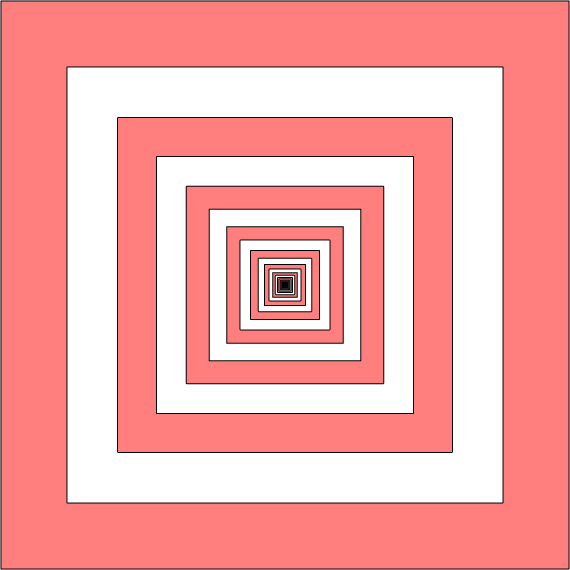
In the figure below, the outside square contains infinitely many squares, each of them with the same center and sides parallel to the outside square. The ratio of the side length of a square to the side length of the next inner square is , where The spaces between squares are alternately shaded as shown in the figure (which is not necessarily drawn to scale).
The area of the shaded portion of the figure is of the area of the original square. What is ?
- A)
- B)
- C)
- D)
- E)
Answer
D
Key insight
The shaded rings form a geometric series with first term 1 - k^2 and ratio k^4, and the sum collapses to (1 - k^2)/(1 - k^4) = 1/(1 + k^2).
Solution
Scale so that the outer square has side and area . The squares then have sides and areas , so the ring between the th and st squares has area
The shading starts with the outermost ring and takes every other one, so the shaded rings are Their areas form a geometric series with first term and ratio :
Setting :
The answer is .
Why this works
Every ring is a scaled copy of the one two steps out, by a factor in length and in area, which is exactly what makes the shaded total a geometric series. The factor then cancels, leaving the memorable formula: shaded fraction , always between and . The cancellation is also a sanity check: as the rings become thin and shading alternates evenly, giving ; as the outer ring swallows everything and the fraction tends to .
Alternative approach
Use self-similarity. Let be the shaded fraction of any such figure. The picture inside the second square is a copy of the whole figure scaled by with the colours swapped, and it occupies area . Hence
with no series summation at all. Then gives as before.
The trap
Setting the outermost ring alone equal to 64%, i.e. 1 - k^2 = 0.64, which gives k = 3/5, choice (A).
Common mistakes
- Setting the outermost ring alone equal to 64%, i.e. 1 - k^2 = 0.64, which gives k = 3/5, choice (A).
- Reading as the value of or of and picking , choice (B).
- Using ratio for the shaded series instead of , which forgets that the unshaded rings sit in between.
Techniques
Apply an identity: SFFT, sum of squares, difference of cubes, Vieta · Cut the figure into known shapes (triangles, rectangles, sectors)