2023 AMC 10A Problem 15
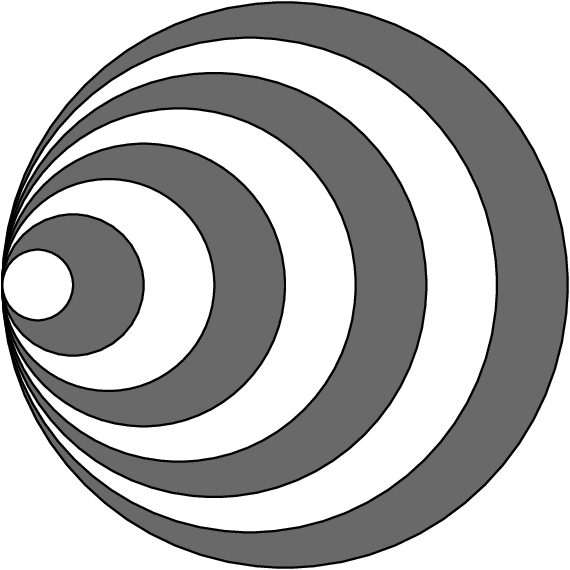
An even number of circles are nested, starting with a radius of and increasing by each time, all sharing a common point. The region between every other circle is shaded, starting with the region inside the circle of radius but outside the circle of radius An example showing circles is displayed below. What is the least number of circles needed to make the total shaded area at least ?
Show solution without answering
Key insight
Each shaded ring is the difference of two circles, and those areas are 3, 7, 11, ... times pi. With n rings the total is n(2n + 1) times pi.
Solution
1. Rings are differences of circles. The circles all touch at one point, but each circle still sits completely inside the next one. So the area between two circles is the big circle's area minus the small one's.
2. Compute the first few shaded rings.
- Between radius and : .
- Between radius and : .
- Between radius and : .
Each shaded ring is bigger than the one before: (times ).
3. Add them up. With circles there are shaded rings. The last one is between radius and , with area . The sum of an evenly spaced list is (number of terms) × (first + last) ÷ 2:
Check with : and . ✓
4. Find the smallest that works. We need . Roughly , so .
- : , too small.
- : , big enough.
5. So we need shaded rings. Each ring uses circles, so that is circles.
The answer is .
Why this works
The area between two circles is a difference of two areas, and the difference of two neighboring squares grows by the same amount each time. That makes the shaded areas an evenly spaced list, which is easy to add up. The circles touching at one point is a distraction; only "each circle is inside the next" matters. The final step is to answer in circles, not rings.
Concise solution
A shorter write-up, the way contest solutions are usually written. It may take a different route from the solution above.
Even though the circles are tangent at a common point rather than concentric, each circle lies inside the next, so the region between the circles of radii and has area
With circles there are shaded rings, for , giving total shaded area
We need . Since suggests : for , ; for , . So rings, which requires circles.
The answer is .
Review in the AoPS books
- Introduction to Algebra, Chapter 21: Sequences & Series (§21.1, §21.2, §21.3, §21.4)
- Introduction to Geometry, Chapter 11: Circles
- Introduction to Algebra, Chapter 20: Special Functions (§20.2, §20.5)
- Introduction to Algebra, Chapter 11: Special Factorizations
Similar problems
Problem © Mathematical Association of America (MAA), American Mathematics Competitions. Reproduced for non-commercial educational use. Solution and commentary are original to this site.