Let be the kite formed by joining two right triangles with legs and along a common hypotenuse. Eight copies of are used to form the polygon shown below. What is the area of triangle ? 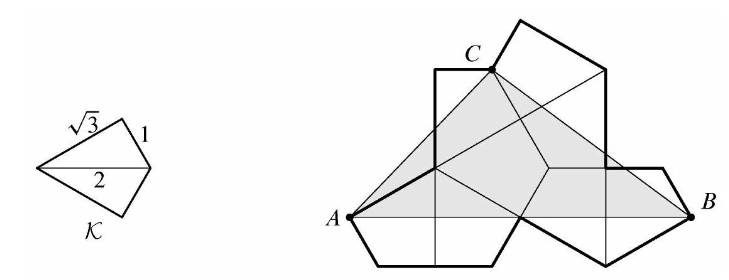
- A)
- B)
- C)
- D)
- E)
Answer
B
Key insight
AB = 3 + 3 is the sum of two bases of isosceles triangles with legs √3 and apex 120°, and C lies 3√3/2 above AB, giving area 9√3/2.
Solution
Gluing two –– triangles along the hypotenuse gives a kite with a corner (where the two sides meet), a corner (where the two unit sides meet), and two right angles. Its long diagonal is the hypotenuse, length , bisecting the and corners.
Let be the polygon vertex directly below , where the thick edge from meets the vertical thick edge. Four kites meet at with their corners.
Length of . Let be the point where the boundary touches between and . The two kites below have right-angle corners and , so and . An isosceles triangle with legs and apex has base and height , so . At the lowest right vertex , two kites meet at corners with right-angle corners and , so likewise. Both bases are horizontal (perpendicular to vertical bisectors), so .
Height of . is the corner of the kite whose corner is , so is that kite's long diagonal, bisecting the angle between the vertical edge at and the edge rising at . Hence makes with the horizontal, is above , and is above : total height .
The answer is .
Why this works
The whole figure lives on a – grid: every kite edge is or and every angle is a multiple of , so lengths along and heights above it come from -- pieces. Identify the special corners ( where sides meet, where unit sides meet) and the base decomposes into two isosceles bases.
Alternative approach
Coordinates with at the origin and horizontal: , , , , . Then and is above line , giving .
The trap
Misreading the kite: its angles are 60°, 90°, 120°, 90° (the two √3 sides meet at 60°, the two unit sides at 120°), and its long diagonal is 2.
Common mistakes
- Misreading the kite: its angles are 60°, 90°, 120°, 90° (the two √3 sides meet at 60°, the two unit sides at 120°), and its long diagonal is 2.
- Assuming is above the midpoint of or that is equilateral; only the base and the height are needed, and is offset toward .
Techniques
Place the figure on coordinates and compute · Cut the figure into known shapes (triangles, rectangles, sectors)