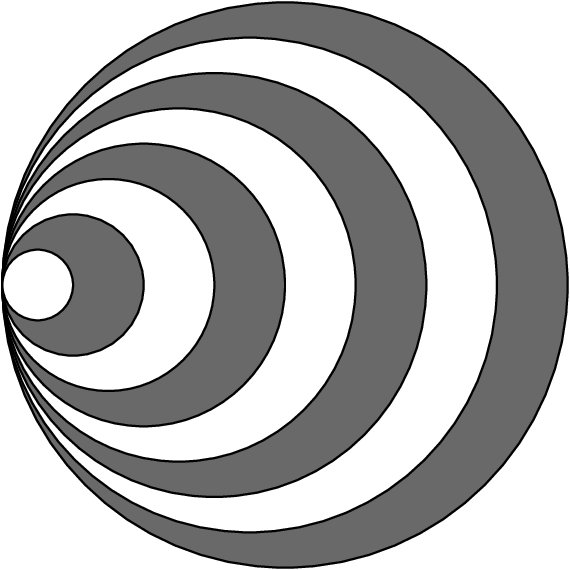
An even number of circles are nested, starting with a radius of and increasing by each time, all sharing a common point. The region between every other circle is shaded, starting with the region inside the circle of radius but outside the circle of radius An example showing circles is displayed below. What is the least number of circles needed to make the total shaded area at least ?
- A)
- B)
- C)
- D)
- E)
Answer
E
Key insight
Each shaded ring between radii 2k-1 and 2k has area (4k-1)pi, so 2n circles shade (2n^2 + n)pi; find the least n with 2n^2 + n >= 2023.
Solution
Even though the circles are tangent at a common point rather than concentric, each circle lies inside the next, so the region between the circles of radii and has area
With circles there are shaded rings, for , giving total shaded area
We need . Since suggests : for , ; for , . So rings, which requires circles.
The answer is .
Why this works
Areas of nested regions are differences of areas, and the difference of consecutive squares is linear, so the shaded total is an arithmetic series with a closed form. The off-center picture is a distraction: only containment matters for subtracting areas. After the algebra, the final trap is a units question: rings versus circles.
Alternative approach
Pair the rings differently: the shaded area with circles equals , an arithmetic series with terms, first term and last term , sum . Same inequality.
The trap
Solving for n and reporting n = 32 instead of the number of circles 2n = 64, or using 2n as the ring count.
Common mistakes
- Solving for n and reporting n = 32 instead of the number of circles 2n = 64, or using 2n as the ring count.
- Shading the wrong rings (starting with the disk of radius ), which gives the sum of and a different threshold.
Techniques
Apply an identity: SFFT, sum of squares, difference of cubes, Vieta · Bound the quantity above/below or estimate to pin it down