2023 AMC 10A Problem 11
A square of area is inscribed in a square of area , creating four congruent triangles, as shown below. What is the ratio of the shorter leg to the longer leg in the shaded right triangle? 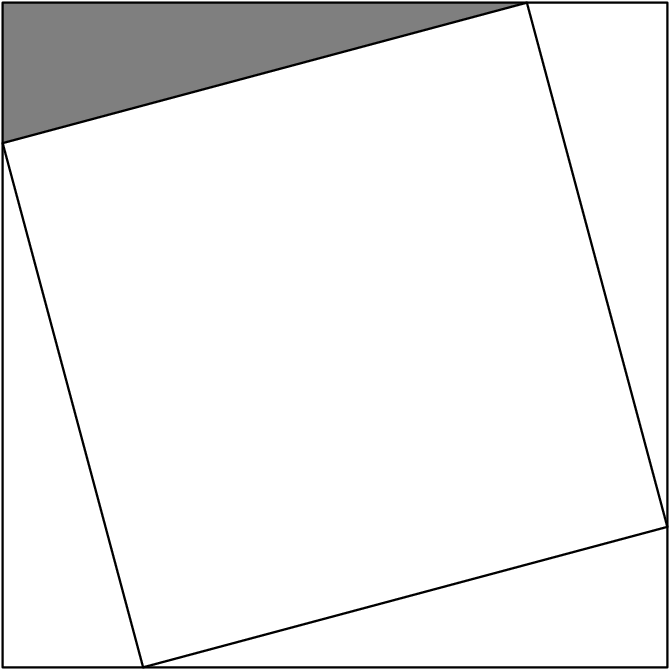
Show solution without answering
Key insight
The legs add to the big square's side and their squares add to 2. That gives their product, and sum plus product gives the ratio.
Solution
1. Read the side lengths. The big square has area , so its side is . The small square has area , so its side is .
2. Name the legs. Call the shaded triangle's short leg and long leg . Look at one side of the big square: it is made of the short leg of one triangle and the long leg of the next. So
3. The hypotenuse of each triangle is a side of the small square, so by the Pythagorean theorem
4. Get the product . Square the first equation: . We already know , so , and .
5. Turn this into the ratio. We want . Divide by :
So .
6. Solve for . Multiply by : , or . The quadratic formula gives
7. Pick the right one. The short leg divided by the long leg is less than . Since , the value is too big, and is the answer.
The answer is .
Why this works
Knowing the sum of two numbers and the sum of their squares tells you their product, because . Sum and product are enough to find anything that treats and fairly, including . Going straight for the ratio avoids ever working out and themselves, which are ugly.
Alternative approach
If you know a little trigonometry: call the small angle of the shaded triangle, opposite the short leg. The legs are and , and they add to . Squaring, , so . That means , so and . The ratio short over long is .
Concise solution
A shorter write-up, the way contest solutions are usually written. It may take a different route from the solution above.
Let the shaded triangle have legs . Its hypotenuse is a side of the inner square, and its two legs together make up a side of the outer square (the four congruent triangles fit corner to corner). Therefore
Squaring the first equation and subtracting the second:
We want . Dividing by gives
So and . Since , we need , so .
The answer is .
Review in the AoPS books
- Introduction to Geometry, Chapter 4: Perimeter and Area (§4.2)
- Introduction to Algebra, Chapter 11: Special Factorizations (§11.2, §11.3, §11.5)
- Introduction to Algebra, Chapter 10: Quadratic Equations – Part 1 (§10.2, §10.3, §10.4)
- Intermediate Algebra, Chapter 20: Some Advanced Strategies (§20.2)
Similar problems
Problem © Mathematical Association of America (MAA), American Mathematics Competitions. Reproduced for non-commercial educational use. Solution and commentary are original to this site.