A square of area is inscribed in a square of area , creating four congruent triangles, as shown below. What is the ratio of the shorter leg to the longer leg in the shaded right triangle? 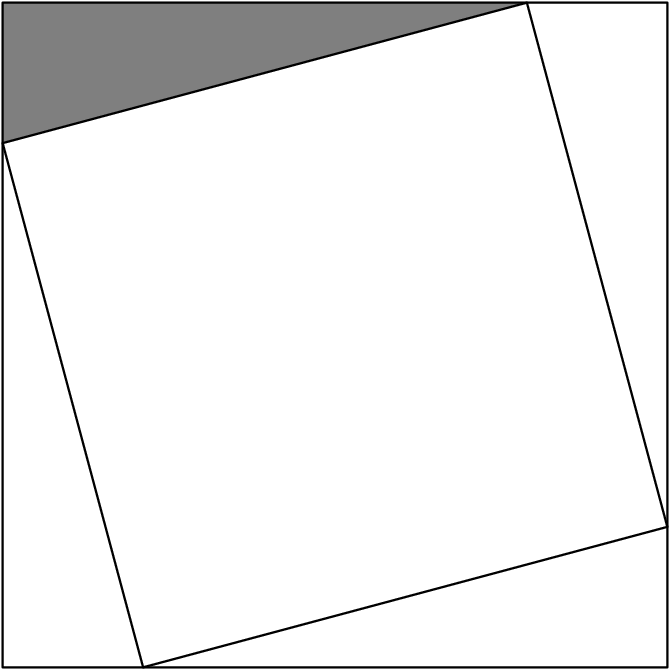
- A)
- B)
- C)
- D)
- E)
Answer
C
Key insight
The legs satisfy a + b = sqrt 3 and a^2 + b^2 = 2, so ab = 1/2 and the ratio r satisfies r + 1/r = 4.
Solution
Let the shaded triangle have legs . Its hypotenuse is a side of the inner square, and its two legs together make up a side of the outer square (the four congruent triangles fit corner to corner). Therefore
Squaring the first equation and subtracting the second:
We want . Dividing by gives
So and . Since , we need , so .
The answer is .
Why this works
Two symmetric facts about the legs (their sum and their sum of squares) determine their product, and sum-plus-product is all you need for any symmetric quantity, including the ratio via . Solving for the ratio directly avoids computing and , which are ugly nested radicals.
Alternative approach
Let be the angle the inner square's side makes with the outer side. Then , so squaring gives and . The ratio is .
The trap
Solving the quadratic for a and b separately with messy nested radicals, or reporting the longer-to-shorter ratio 2 + sqrt 3.
Common mistakes
- Solving the quadratic for a and b separately with messy nested radicals, or reporting the longer-to-shorter ratio 2 + sqrt 3.
- Setting equal to the inner side instead of the outer side .
Techniques
Apply an identity: SFFT, sum of squares, difference of cubes, Vieta · Substitute to simplify (u = x+1/x, shifting, scaling)