A bowl is formed by attaching four regular hexagons of side to a square of side . The edges of the adjacent hexagons coincide, as shown in the figure. What is the area of the octagon obtained by joining the top eight vertices of the four hexagons, situated on the rim of the bowl? 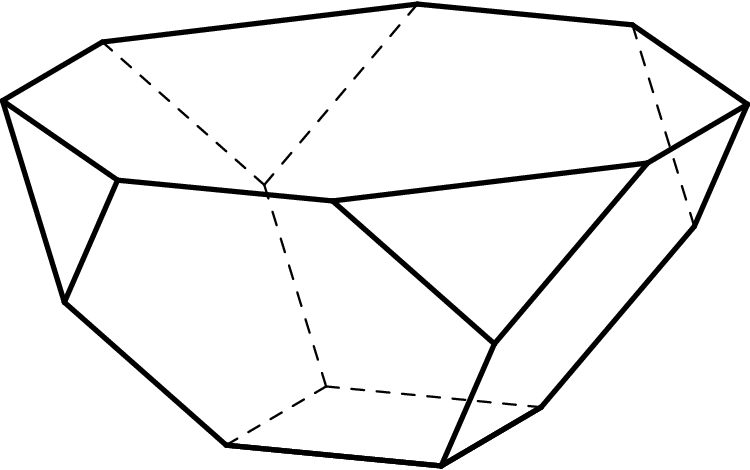
- A)
- B)
- C)
- D)
- E)
Answer
B
Key insight
The shared slanted edge shows each hexagon's top edge sits horizontally 1 unit outside the square, so the rim is a 3 by 3 square with four corner triangles removed.
Solution
Put the square in the horizontal plane with corners , , , . By the square's symmetry all four hexagons tilt equally, so the eight rim vertices are at one common height: the octagon is horizontal, and its area equals the area of its top view.
Look at hexagon on the side from to and hexagon on the side from to . They share the edge rising from the corner to a vertex . In a regular hexagon of side , the vertex adjacent to one end of a side lies farther along that side's direction and away perpendicular to it, within the hexagon's plane. The plane of contains the -direction, so has -coordinate ; the plane of contains the -direction, so has -coordinate . Thus the in-plane perpendicular offset in projects to a horizontal offset of exactly outward (from to ).
The top edge of is at in-plane distance from its base edge, so it projects twice as far: seen from above it runs from to . By symmetry the four top edges project to -, -, -, -, and the other four rim edges join consecutive ones, such as -.
The octagon is therefore the square with corners , , , with four isosceles right triangles of legs cut off:
The answer is .
Why this works
A symmetric three-dimensional figure is best measured through a well-chosen projection: the rim is horizontal, so its area is visible from above. The only unknown was the tilt of the hexagons, and a shared edge, viewed from two hexagons at once, pins it down with no trigonometry. Once the tilt is known, everything about the rim follows by symmetry.
Alternative approach
Sanity check the heights: is unit from with horizontal displacement , so its height is , and the top edge, at in-plane distance with horizontal offset , is at height , consistent with a rising bowl.
The trap
Guessing the octagon is regular or that the hexagons stand vertically; the rim's sides alternate 1 and sqrt(2), and the tilt is fixed by the shared edges.
Common mistakes
- Guessing the octagon is regular or that the hexagons stand vertically; the rim's sides alternate 1 and sqrt(2), and the tilt is fixed by the shared edges.
- Computing the area of a regular octagon of side () or misreading the top view as a square without the cut corners ().
Techniques
Place the figure on coordinates and compute · Cut the figure into known shapes (triangles, rectangles, sectors) · Exploit symmetry to reduce work or pair up objects