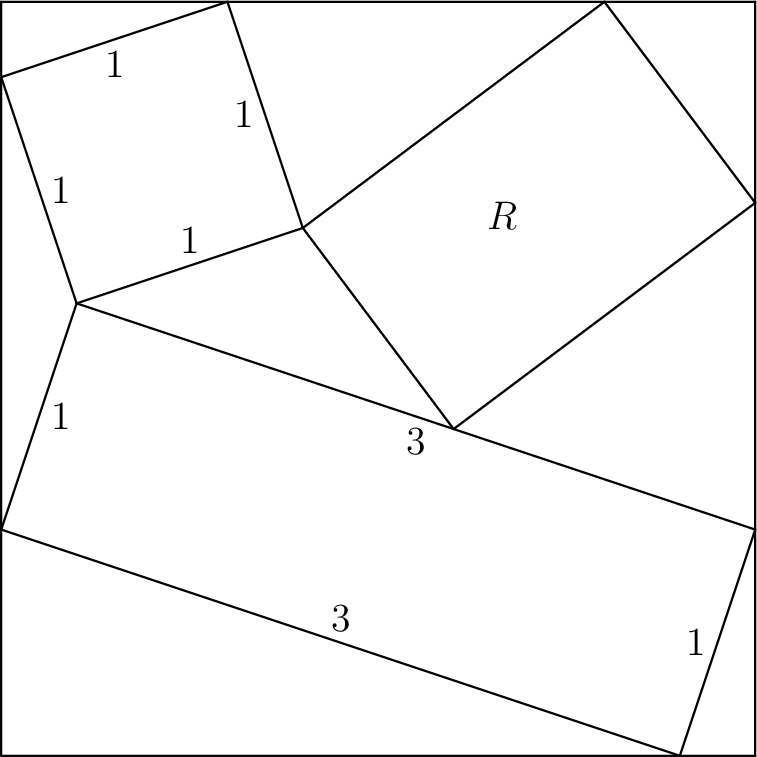
A rectangle with side lengths and a square with side length and a rectangle are inscribed inside a larger square as shown. The sum of all possible values for the area of can be written in the form , where and are relatively prime positive integers. What is
- A)
- B)
- C)
- D)
- E)
Answer
E
Key insight
The 1x3 rectangle and unit square force tan(theta) = 1/3 and side sqrt(10); then R's tilt satisfies a quadratic with two valid roots.
Solution
Step 1: the fixed pieces. Let the rectangle's long side make angle with the horizontal, its corners on the left, bottom and right sides of the big square. Its horizontal span is the big side, ; its top corner has height and is from the left side.
The unit square has a vertex at , one on the left side and one on the top. Its side from to the left side has run , hence rise ; the next side rises more to reach the top, so . Equating: and .
Step 2: coordinates. Scale by so the big square is . The rectangle's top side is the segment of from to , and the unit square's free vertex is .
Step 3: rectangle . has vertex , vertex on , a vertex on , and vertex on . Let its sides from be toward and toward . The conditions are , , and . With they combine to
so or .
For : , , area . For : , area . Both fit in the square. Areas scale by , so the true areas sum to , giving .
The answer is .
Why this works
Two of the three inscribed pieces are rigid enough to fix the big square completely, and the phrase "all possible values" signals that the last piece has a free parameter with finitely many valid settings. Three incidence conditions on three unknowns (tilt and two side lengths) produce a quadratic, hence two configurations. Choosing coordinates that make the picture integral () keeps the algebra clean.
The trap
Assuming R must be parallel to the 1x3 rectangle or to the unit square, which finds only one of the two configurations.
Common mistakes
- Assuming R must be parallel to the 1x3 rectangle or to the unit square, which finds only one of the two configurations.
- Forgetting to convert areas back after scaling the picture by (areas scale by ), or reporting one area instead of the sum.
Techniques
Place the figure on coordinates and compute · Substitute to simplify (u = x+1/x, shifting, scaling)