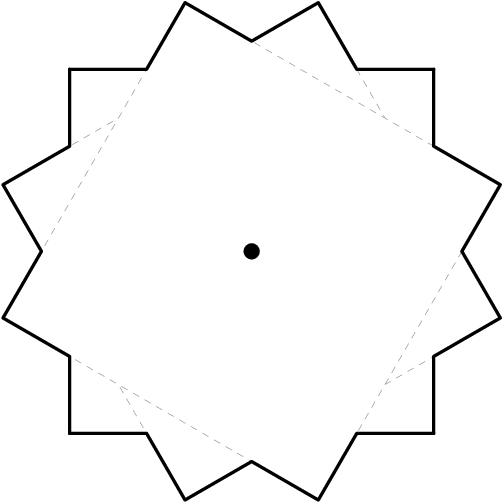
Three identical square sheets of paper each with side length are stacked on top of each other. The middle sheet is rotated clockwise about its center and the top sheet is rotated clockwise about its center, resulting in the -sided polygon shown in the figure below. The area of this polygon can be expressed in the form , where , , and are positive integers, and is not divisible by the square of any prime. What is
- A)
- B)
- C)
- D)
- E)
Answer
E
Key insight
The 24-gon has 12-fold symmetry: its 24 vertices alternate between square corners (every 30 degrees) and side intersections exactly halfway between, so it splits into 24 congruent triangles.
Solution
Put the common center at the origin with the bottom sheet axis-aligned, so its corners are at , at angles from the center. The other sheets' corners sit at the same distance, every : the twelve corners are at .
Rotating the whole picture by sends each sheet to another sheet, so the polygon has -fold rotational symmetry; reflecting in the line at angle swaps the and sheets and fixes the sheet, so that line is a mirror as well. Hence the vertices are the corners together with intersection points, one on each bisecting ray at .
Consider the corner of the bottom sheet and the intersection point on the ray at . lies on the bottom sheet's side , so .
Triangle has base along the line and height (the distance from to that line), so its area is
The polygon is made of such triangles (one for each corner-to-neighbor half-step), so its area is
Then .
The answer is .
Why this works
Overlapping congruent shapes about a common center create rotational symmetry; find the smallest symmetric wedge and multiply. The key fact was that the boundary vertices alternate corner, intersection, corner, at equal angular spacing, which places each intersection on a known ray and makes its coordinates trivial.
Alternative approach
Same wedge via the law of sines: triangle has angles at , at and at with , so , and the area follows as above.
The trap
Assuming the intersection points lie at the same distance from the center as the corners, or computing the union as the square area plus a guessed number of protruding triangles.
Common mistakes
- Assuming the intersection points lie at the same distance from the center as the corners, or computing the union as the square area plus a guessed number of protruding triangles.
- Using the regular dodecagon through the twelve corners () as the answer, which drops the small triangles beyond it.
Techniques
Cut the figure into known shapes (triangles, rectangles, sectors) · Exploit symmetry to reduce work or pair up objects