A square with side length is inscribed in an isosceles triangle with one side of the square along the base of the triangle. A square with side length has two vertices on the other square and the other two on sides of the triangle, as shown. What is the area of the triangle?
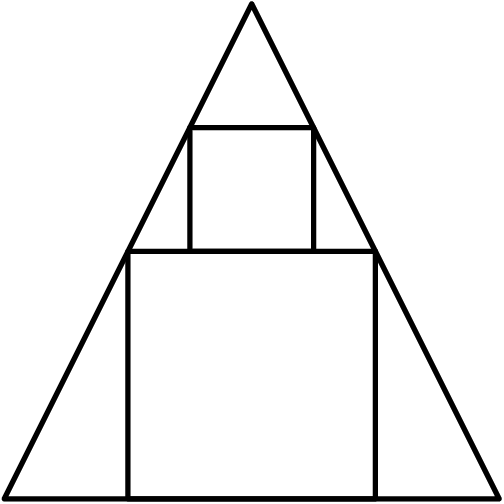
- A)
- B)
- C)
- D)
- E)
Answer
B
Key insight
The triangle's width shrinks linearly with height: it is 3 at height 3 and 2 at height 5, so it is 9/2 at height 0 and 0 at height 9.
Solution
Measure heights from the base. A horizontal slice of the triangle at height has some width ; because the two slanted sides are straight lines, is a linear function of .
The big square's top corners lie on the triangle's sides at height , so . The small square sits on top of the big one, so its top corners are at height and lie on the sides: .
Going up units shrinks the width by , so the width shrinks per unit of height. Therefore
The triangle has base and height , so its area is
The answer is .
Why this works
Every horizontal cross-section of a triangle is similar to its base, so width is linear in height; two measured widths determine the whole triangle. This "linear taper" viewpoint packages the similar-triangles argument into a single slope computation and works for any stack of inscribed rectangles.
Alternative approach
Similar triangles explicitly: the small triangle above height has base ; the triangle above height has base . Their heights are in ratio and differ by , so they are and . The apex is at height , and the full triangle is similar with height and base .
The trap
Assuming the small square's top corners are at height 6 or that the apex sits directly above the big square's top corners, instead of using the two known widths.
Common mistakes
- Assuming the small square's top corners are at height 6 or that the apex sits directly above the big square's top corners, instead of using the two known widths.
- Computing the base as by tapering over the wrong height interval.
Techniques
Add construction lines/points (drop altitudes, extend segments, connect centers) · Set up the equation/formula and compute; no special trick needed