A square with side length is colored white except for black isosceles right triangular regions with legs of length in each corner of the square and a black diamond with side length in the center of the square, as shown in the diagram. A circular coin with diameter is dropped onto the square and lands in a random location where the coin is completely contained within the square. The probability that the coin will cover part of the black region of the square can be written as , where and are positive integers. What is ? 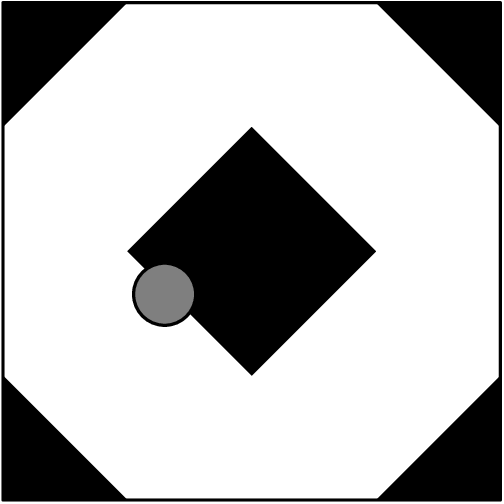
- A)
- B)
- C)
- D)
- E)
Answer
C
Key insight
The center lives in a 7×7 square; it hits black iff within 1/2 of a black shape, so expand the diamond by 1/2 and clip each corner triangle.
Solution
The coin has radius , so its center is uniformly distributed over the square of points at least from every side (area ). The coin touches black exactly when its center is within of a black region. We find the area of that "bad" set.
Diamond. The diamond is a square with diagonals and , area , perimeter . Points within of a convex polygon form the polygon, plus a strip of width along each side, plus quarter-discs at the vertices that together make one full disc of radius :
Corner triangles. Take the corner at the origin: the triangle with vertices . Allowed centers have , so they are already at least from the two legs; only the hypotenuse matters. A center is within of it when . The bad set is the right isosceles triangle with vertex and legs :
Four corners: .
Total. Bad area , so the probability is
Hence .
The answer is .
Why this works
Replace the coin by its center: the sample space is a shrunken square, and "coin touches region" becomes "center lies in the region grown by the radius." Growing a convex polygon adds strips along edges and a full disc's worth of corner sectors, which is where the comes from. The corner triangles are different only because part of their grown region is cut off by where the center is allowed to be; always intersect with the sample space.
The trap
Treating the corner triangles like the diamond, adding quarter-circles or strips along their legs, which lie outside the region the center can occupy.
Common mistakes
- Treating the corner triangles like the diamond, adding quarter-circles or strips along their legs, which lie outside the region the center can occupy.
- Dividing by (the full square) instead of , or using diameter as the growth distance instead of the radius .
Techniques
Cut the figure into known shapes (triangles, rectangles, sectors)