2018 AMC 10B Problem 10
In the rectangular parallelepiped shown, , , and . Point is the midpoint of . What is the volume of the rectangular pyramid with base and apex ?
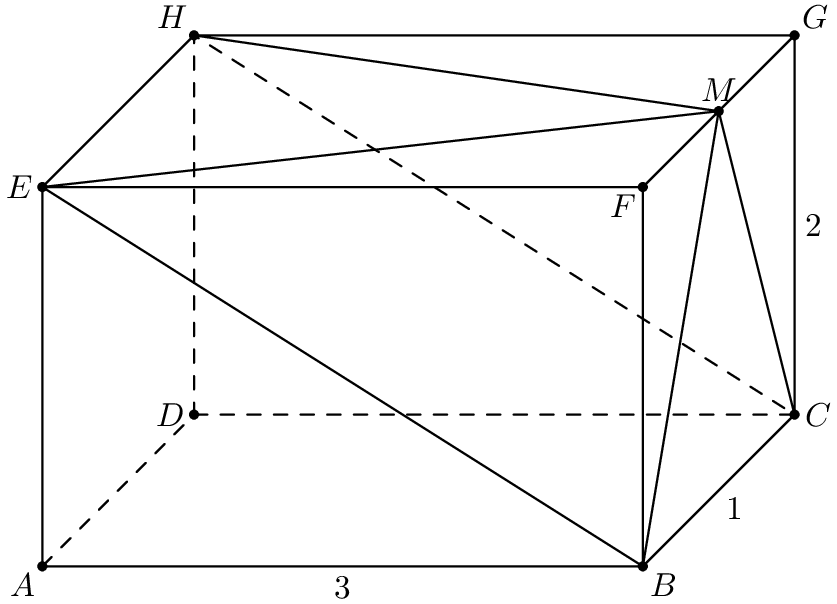
Show solution without answering
Key insight
The base is a slanted 1-by-square-root-of-13 rectangle. The height is the distance from M to that slanted rectangle, which you can measure from F in the front face.
Solution
A pyramid's volume is , where the height is measured straight to the base. The base here is tilted, so be careful with the height.
1. The base. is a rectangle. One side is . The other side runs diagonally across the face , which is by , so
The base area is .
2. Move the apex to make the height easier. The edge runs parallel to , which lies in the base. So every point of is the same distance from the base. That means is exactly as far from the base as is.
3. Find the distance from in a flat picture. Look straight at the face . The slanted base shows up as the line , and is the corner of the right triangle with legs and . (This works because the base rectangle stands straight out from this face, along .) The distance from to the base is the height of this right triangle drawn to its long side .
4. Compute that height. Find the triangle's area two ways. Using the legs, the area is . Using as the base, the area is . So
5. Volume.
The answer is .
Why this works
Sliding the apex along a line parallel to the base does not change the height, so you can pick the easiest point. When the tilted base stands straight out from one face of the box, the 3-D distance becomes a 2-D distance in that face, and the "area two ways" trick finds it.
Alternative approach
Cut the box along the rectangle . The box has volume , so each half is a wedge of volume . The half containing and is a wedge with triangle ends and . A pyramid inside this wedge, with the rectangle as base and its tip on the opposite edge , takes up of the wedge (the rest is a smaller pyramid of ). So the volume is . Since is on edge , the pyramid with tip has this same volume.
Concise solution
A shorter write-up, the way contest solutions are usually written. It may take a different route from the solution above.
The base is a rectangle: , and is a diagonal of the face , so . Its area is .
For the height we need the distance from to the plane . Segment is parallel to , hence parallel to that plane, so every point of is the same distance from it; in particular is as far from the plane as is.
Look at the face : the plane cuts it along , and the plane is perpendicular to this face (it contains , which is perpendicular to the face). So the distance from to the plane is just the distance from to the line inside the face, i.e. the altitude from the right angle in triangle with legs and :
Volume:
The answer is .
Review in the AoPS books
- Introduction to Geometry, Chapter 14: Three-Dimensional Geometry
- Introduction to Geometry, Chapter 4: Perimeter and Area (§4.2)
- Introduction to Geometry, Chapter 19: Problem Solving Strategies in Geometry (§19.1)
- Introduction to Geometry, Chapter 15: Curved Surfaces
Similar problems
Problem © Mathematical Association of America (MAA), American Mathematics Competitions. Reproduced for non-commercial educational use. Solution and commentary are original to this site.