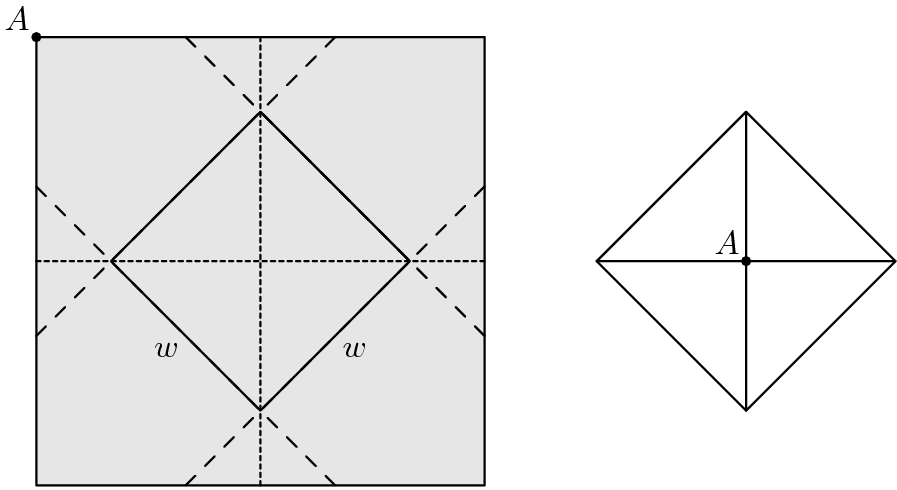
A closed box with a square base is to be wrapped with a square sheet of wrapping paper. The box is centered on the wrapping paper with the vertices of the base lying on the midlines of the square sheet of paper, as shown in the figure on the left. The four corners of the wrapping paper are to be folded up over the sides and brought together to meet at the center of the top of the box, point in the figure on the right. The box has base length and height . What is the area of the sheet of wrapping paper?
- A)
- B)
- C)
- D)
- E)
Answer
A
Key insight
Along a diagonal of the sheet, the half-diagonal runs w/2 to the box's side, h up the side, and w/2 across the top, so the side is sqrt(2)(w+h).
Solution
Follow one diagonal of the sheet from its center out to a corner . The box's base is tilted relative to the sheet, so this diagonal is perpendicular to one side of the base and crosses that side at its midpoint, a distance from .
From there the paper folds up that side face. The diagonal stays perpendicular to the bottom edge, so it climbs straight up the face: length . At the top edge it folds again and runs along the top face, perpendicular to that edge, until the corner lands on the top's center : another .
Hence the half-diagonal of the sheet is
so the full diagonal is . A square with diagonal has area :
The answer is .
Why this works
Folding does not change lengths, so a straight path on the flat sheet becomes a chain of straight segments on the box. Pick the path with the simplest geometry, here a diagonal, which stays perpendicular to every crease it meets, and add the pieces. Knowing the diagonal of a square determines its area without ever finding the side.
Alternative approach
Sanity-check the choices with an extreme case. If the box is a thin pole of height ; a corner of the sheet must reach the top, so the half-diagonal is and the area is . Only (A) gives when : (B) gives , and (C), (D), (E) give .
The trap
Assuming the paper area equals the box's surface area 2w^2 + 4wh (choice C); the four corner flaps overlap on the top, so the sheet is larger than the box's surface.
Common mistakes
- Assuming the paper area equals the box's surface area 2w^2 + 4wh (choice C); the four corner flaps overlap on the top, so the sheet is larger than the box's surface.
- Forgetting that the corner must travel across the top to reach the center , which gives a half-diagonal of and an area of .
Techniques
Use the answer choices (mod checks, size, form) to eliminate or select · Add construction lines/points (drop altitudes, extend segments, connect centers)