2018 AMC 10A Problem 9
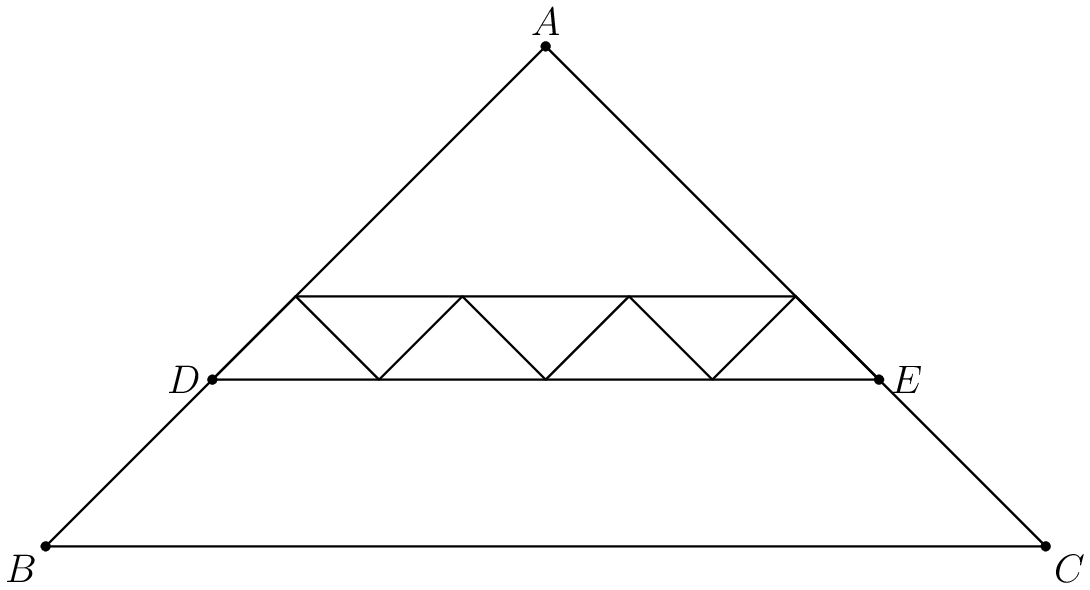
All of the triangles in the diagram below are similar to isosceles triangle , in which . Each of the smallest triangles has area and has area . What is the area of trapezoid ?
Show solution without answering
Key insight
Four small triangles fit side by side along DE, so triangle ADE is a small one scaled up 4 times, with area 4 times 4 = 16.
Solution
The trapezoid is the big triangle with the top triangle cut off. We know has area , so we only need the area of .
- Measure in small triangles. Look along the segment . Four of the small triangles point upward and sit with their bottom sides on ; the other three point downward and fill the gaps. The four bottom sides cover exactly, so is times as long as the base of one small triangle.
- Compare with a small triangle. Every triangle in the picture has the same shape. So is a small triangle blown up times in every direction.
- How does area grow? If a shape is stretched times as wide and times as tall, its area grows by . A small triangle has area , so has area .
- Subtract. The trapezoid has area .
The answer is .
Why this works
For two shapes of the same shape, if lengths are times as long, areas are times as big. The picture gives the length ratio for free by lining small triangles up along . After that, cutting off a known triangle from a known triangle is just a subtraction.
Alternative approach
Count pieces inside . The small triangles form a strip of area . Its top edge is small bases long, so the triangle sitting above the strip is a small triangle blown up times, with area . So has area , and the trapezoid again has area .
Concise solution
A shorter write-up, the way contest solutions are usually written. It may take a different route from the solution above.
The trapezoid is what remains of after removing , so we need the area of .
Along sit four of the small triangles with their bases on (the other three point downward and fill the gaps). Those four bases exactly cover , so is times the base of a small triangle.
Since is similar to each small triangle (all triangles in the figure are similar to ), its area is the small area scaled by :
Therefore
The answer is .
Review in the AoPS books
- Introduction to Geometry, Chapter 3: Congruent Triangles
- Introduction to Geometry, Chapter 8: Quadrilaterals
- Introduction to Geometry, Chapter 5: Similar Triangles
- Introduction to Geometry, Chapter 9: Polygons (§9.3)
Similar problems
Problem © Mathematical Association of America (MAA), American Mathematics Competitions. Reproduced for non-commercial educational use. Solution and commentary are original to this site.