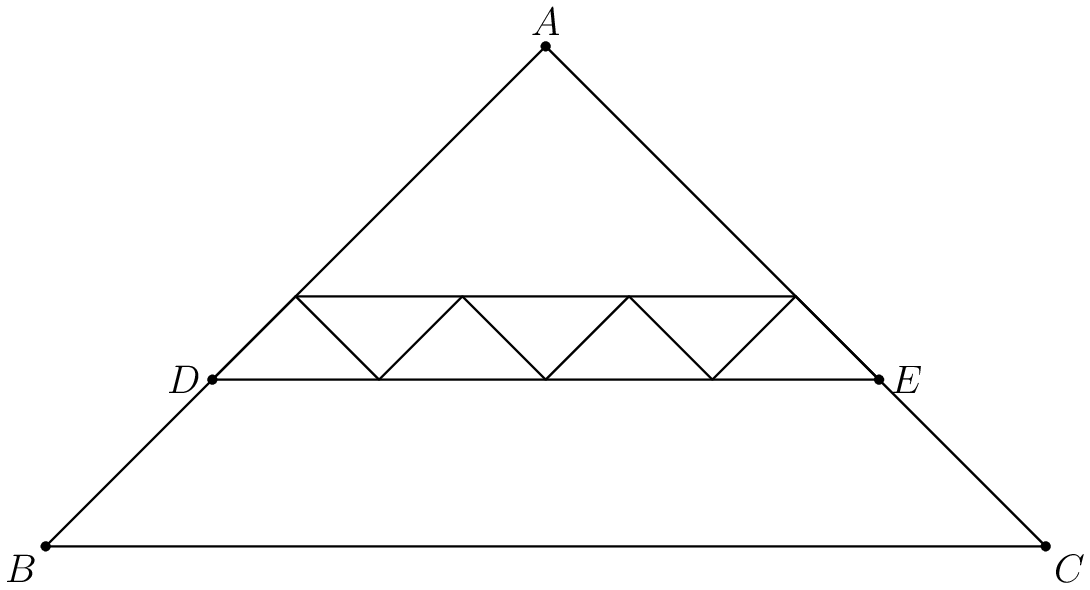
All of the triangles in the diagram below are similar to isosceles triangle , in which . Each of the smallest triangles has area and has area . What is the area of trapezoid ?
- A)
- B)
- C)
- D)
- E)
Answer
E
Key insight
Segment DE is four small bases long, so triangle ADE is the small triangle scaled by 4 and has area 16; the trapezoid is 40 - 16.
Solution
The trapezoid is what remains of after removing , so we need the area of .
Along sit four of the small triangles with their bases on (the other three point downward and fill the gaps). Those four bases exactly cover , so is times the base of a small triangle.
Since is similar to each small triangle (all triangles in the figure are similar to ), its area is the small area scaled by :
Therefore
The answer is .
Why this works
For similar figures, area scales with the square of the length ratio. The only measurement needed is the ratio of to a small base, and the picture hands it over: four small triangles stand shoulder to shoulder along . Everything else (the total area ) is given, so the trapezoid is a subtraction.
Alternative approach
Count pieces: the seven small triangles form a strip of area whose top edge is small bases long. The triangle above the strip is the small triangle scaled by , area . So and the trapezoid is .
The trap
Adding up the seven small triangles and stopping (area 7) or scaling the area by 4 instead of by 4^2.
Common mistakes
- Adding up the seven small triangles and stopping (area 7) or scaling the area by 4 instead of by 4^2.
- Trying to read the ratio from the picture, which is not drawn to scale; only the counted bases are reliable.
Techniques
Set up the equation/formula and compute; no special trick needed