2018 AMC 10A Problem 15
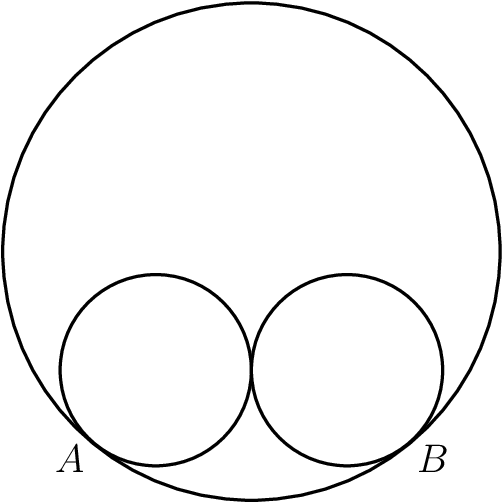
Two circles of radius are externally tangent to each other and are internally tangent to a circle of radius at points and , as shown in the diagram. The distance can be written in the form , where and are relatively prime positive integers. What is ?
Show solution without answering
Key insight
A touching point lies on the line through both centers. Stretching the center segments from 8 to 13 turns triangle OPQ into triangle OAB.
Solution
Circle problems become triangle problems once you connect the centers. Let be the center of the big circle, and , the centers of the small circles that touch the big one at and .
1. Big circle and a small circle touching at . When two circles touch, the touching point lies on the line through their centers. So , , are on one line. The distance is the big radius, , and is the small radius, , so . In the same way, , , are on one line with and .
2. The two small circles touch each other. Their centers are one radius plus the other apart: .
3. Compare two triangles. Triangle is triangle stretched away from : both and are times as long as and , and the angle at is the same. So the two triangles have the same shape, and every length in is times the matching length in .
4. Find .
5. Finish. and share no common factor, so .
The answer is .
Why this works
Touching circles give two facts for free: the touching point is on the line of centers, and the distance between centers is the sum of radii (touching from outside) or the difference (one inside the other). Drawing those segments turns the picture into two triangles of the same shape sharing the corner , so one scale factor gives the answer.
Alternative approach
Coordinates. Put and the small centers at and , so . Since , we need , so . The point is on the ray from through at distance , so ; likewise . Their -coordinates are and their -coordinates match, so .
Concise solution
A shorter write-up, the way contest solutions are usually written. It may take a different route from the solution above.
Let be the center of the big circle and , the centers of the small circles tangent at and respectively. Draw the segments joining the centers.
- Internal tangency at : , , are collinear with and . Likewise , .
- External tangency of the small circles: .
Triangles and share the angle at , and , so they are similar with ratio . Hence
Since , .
The answer is .
Review in the AoPS books
- Introduction to Geometry, Chapter 11: Circles
- Introduction to Geometry, Chapter 3: Congruent Triangles
- Introduction to Geometry, Chapter 19: Problem Solving Strategies in Geometry (§19.1)
- Introduction to Geometry, Chapter 12: Circles and Angles
Similar problems
Problem © Mathematical Association of America (MAA), American Mathematics Competitions. Reproduced for non-commercial educational use. Solution and commentary are original to this site.