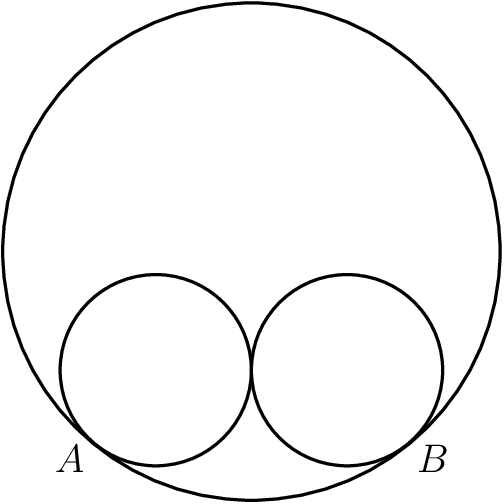
Two circles of radius are externally tangent to each other and are internally tangent to a circle of radius at points and , as shown in the diagram. The distance can be written in the form , where and are relatively prime positive integers. What is ?
- A)
- B)
- C)
- D)
- E)
Answer
D
Key insight
Tangency points lie on the lines of centers, so A and B extend OP and OQ from length 8 to 13; triangle OAB is triangle OPQ scaled by 13/8.
Solution
Let be the center of the big circle and , the centers of the small circles tangent at and respectively. Draw the segments joining the centers.
- Internal tangency at : , , are collinear with and . Likewise , .
- External tangency of the small circles: .
Triangles and share the angle at , and , so they are similar with ratio . Hence
Since , .
The answer is .
Why this works
Tangent circles come with two free facts: the point of tangency is on the line of centers, and the distance between centers is (external) or (internal). Drawing all the center-to-center and center-to-tangency segments turns a circle problem into a triangle problem, and here the triangle is just a dilation of from the common vertex .
Alternative approach
Coordinates: put and , with , so . Then and , so . The similarity does the same work without the square root.
The trap
Taking the small centers to be 13 - 5 = 8 apart (instead of 10, the sum of their radii) or forgetting that A lies on line OP beyond P.
Common mistakes
- Taking the small centers to be 13 - 5 = 8 apart (instead of 10, the sum of their radii) or forgetting that A lies on line OP beyond P.
- Placing and at the same height as and (so or -ish guesses), or computing the height by coordinates and making a radical error; the similarity ratio needs no square roots.
Techniques
Add construction lines/points (drop altitudes, extend segments, connect centers)