The letter F shown below is rotated clockwise around the origin, then reflected in the -axis, and then rotated a half turn around the origin. What is the final image?
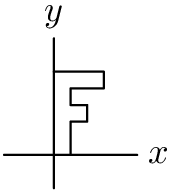

- A)
- B)
- C)
- D)
- E)
Answer
E
Key insight
Track a general point: (x,y) goes to (y,-x), then (-y,-x), then (y,x), so the three moves together are one reflection across the line y = x.
Solution
Follow a general point through the three moves.
- Rotation clockwise about the origin: .
- Reflection in the -axis: .
- Half turn about the origin: .
The net map is : a reflection across the line .
Now apply it to the F. Its stem runs up from the -axis along , with the two arms pointing right and the long top bar at . Swapping coordinates turns the stem into a segment along starting at the -axis, the arms now point up, and the long bar becomes vertical at . That is an F lying on its back in the first quadrant, which is picture (E).
The answer is .
Why this works
Composite transformations are easiest to handle algebraically: write each as a coordinate rule and compose. An odd number of reflections yields a mirror image, so the answer had to be a reflected F rather than a rotated one, which alone eliminates (A), (C) and (D). The specific reflection line then picks (E) over (B).
Alternative approach
Track two landmark points. The foot of the stem goes , and the tip of the top bar goes . Only picture (E) has the stem starting on the -axis at and the bar ending at .
The trap
Turning the wrong way for the clockwise rotation or doing the steps out of order; any answer that is merely a rotated F (not a mirror image) is wrong.
Common mistakes
- Turning the wrong way for the clockwise rotation or doing the steps out of order; any answer that is merely a rotated F (not a mirror image) is wrong.
- Reflecting in the -axis instead of the -axis, which produces the mirror image in a different position.
Techniques
Place the figure on coordinates and compute · Test small/specific values or special cases to find or verify the answer