2015 AMC 10B Problem 22
In the figure shown below, is a regular pentagon and . What is ? 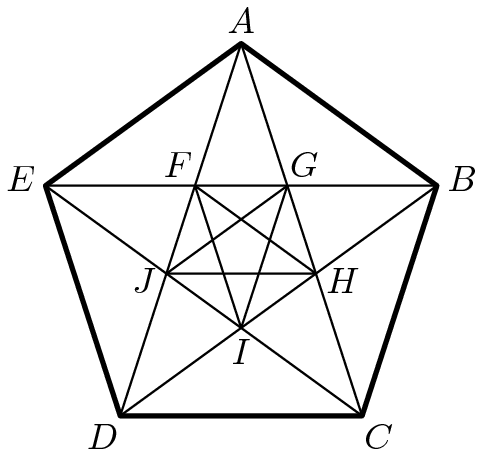
Show solution without answering
Key insight
Every triangle in the figure has angles 36, 72, 108 degrees, so lengths grow by the golden ratio: FG = 1/phi, JH = 1, CD = phi.
Solution
Step 1: the angles. Each corner of a regular pentagon is . The two lines from a corner to the far corners split that into three equal angles of . So every triangle in the picture has angles made from , and .
Step 2: the one number we need. Let , the golden ratio. Two facts about it:
- and .
- In a triangle with angles , , , each long side is times the short side. (If you cut one angle in half, you get a smaller triangle with the same angles, and matching up the sides gives exactly this ratio.)
Step 3: and . In triangle , the angles at and at are both . Two equal angles mean two equal sides, so . The pentagon looks the same when flipped left-to-right across the line through and the middle of the opposite side; that flip swaps and and swaps and . So .
Step 4: . In triangle , the angle at is and , so the other two angles are each. The long sides are , so the short side is
The small pentagon in the middle is also regular, so all its sides are , including .
Step 5: . Along the diagonal :
Triangle has angles , , , with long sides . So its short side is
This matches the pattern in the big pentagon: a diagonal () is times a side ().
Step 6: . In the small pentagon, and are not next to each other (the corner is between them), so is a diagonal of the small pentagon. By the same pattern, a diagonal is times a side:
Step 7: add.
The answer is .
Why this works
A regular pentagon with all its diagonals is built from triangles with angles , and , and in all of them the long side is times the short side. So once one length is known, every length is that number times a power of . The rule turns messy square-root arithmetic into simple adding. Worth remembering: in a regular pentagon, a diagonal is times a side.
Concise solution
A shorter write-up, the way contest solutions are usually written. It may take a different route from the solution above.
Each interior angle is and each diagonal makes a angle with the adjacent sides, so every triangle in the figure has angles from . Let , so and . Standard fact: in a -- triangle, base (bisect a base angle to get a similar triangle: ).
and . In , , so . The reflection through 's axis of symmetry swaps and , hence , so as well.
. In , and , so it is -- with legs : . By symmetry the inner pentagon is regular with side , so too.
. . Triangle is -- with legs , so .
. and are non-adjacent vertices of the inner pentagon, so is its diagonal: .
Therefore
The answer is .
Review in the AoPS books
- Introduction to Geometry, Chapter 2: Angles
- Introduction to Geometry, Chapter 3: Congruent Triangles
- Introduction to Algebra, Chapter 22: Special Manipulations (§22.3)
- Introduction to Algebra, Chapter 11: Special Factorizations
Similar problems
Problem © Mathematical Association of America (MAA), American Mathematics Competitions. Reproduced for non-commercial educational use. Solution and commentary are original to this site.