2009 AMC 10B Problem 24
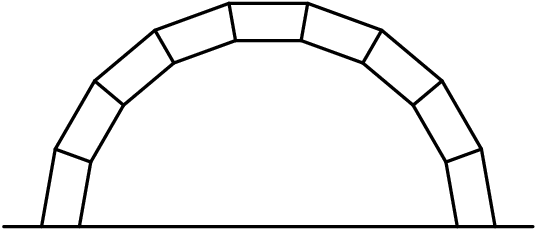
The keystone arch is an ancient architectural feature. It is composed of congruent isosceles trapezoids fitted together along the non-parallel sides, as shown. The bottom sides of the two end trapezoids are horizontal. In an arch made with trapezoids, let be the angle measure in degrees of the larger interior angle of the trapezoid. What is ?
Show solution without answering
Key insight
Extend the slanted sides of all the trapezoids down to the center of the arch. The nine trapezoids split the 180 degree straight angle into nine 20 degree slices.
Solution
The arch looks like a half ring, so look for its center.
1. Extend the two slanted sides (the legs) of each trapezoid downward. Because the trapezoids are all the same and are glued leg to leg, all these lines meet at one point on the ground line, the center of the arch.
2. The arch runs from the ground on the left to the ground on the right, which is a straight angle of at . The nine trapezoids split it into nine equal slices:
3. So each trapezoid is a tall thin isosceles triangle with a angle at , with its tip near cut off by a line parallel to the far side.
4. The two other angles of that triangle are equal and share , so each is . These are the trapezoid's angles at its longer, outer side.
5. The inner side is parallel to the outer side, so each angle at the inner side makes with the outer angle on the same leg: .
6. The larger angle of the trapezoid is .
The answer is .
Why this works
Identical pieces arranged around a point share a center, and extending their edges finds it. That turns the arch into equal slices of a straight angle, and each trapezoid is just a triangle with its tip cut off. Check with the picture: the end trapezoid sits flat on the ground and its outer leg leans at , which looks right.
Concise solution
A shorter write-up, the way contest solutions are usually written. It may take a different route from the solution above.
Extend the non-parallel sides (legs) of every trapezoid downward. Since the trapezoids are congruent and glued leg to leg, all these lines pass through a single point on the ground line, the center of the arch. The arch spans a straight angle at , and the nine trapezoids divide it evenly, so each trapezoid sits inside a wedge of
Each trapezoid is an isosceles triangle with apex and apex angle , with its tip cut off by a line parallel to the base. The base angles of that triangle are ; these are the trapezoid's angles at its longer (outer) base.
The angles at the shorter (inner) base are supplementary to these, because the two bases are parallel: . That is the larger interior angle.
The answer is .
Review in the AoPS books
- Introduction to Geometry, Chapter 2: Angles
- Introduction to Geometry, Chapter 16: The More Things Change. . . (§16.1, §16.2, §16.3, §16.4)
- Introduction to Geometry, Chapter 19: Problem Solving Strategies in Geometry (§19.1)
- Introduction to Algebra, Chapter 22: Special Manipulations (§22.3)
Similar problems
Problem © Mathematical Association of America (MAA), American Mathematics Competitions. Reproduced for non-commercial educational use. Solution and commentary are original to this site.