In the figure shown below, is a regular pentagon and . What is ? 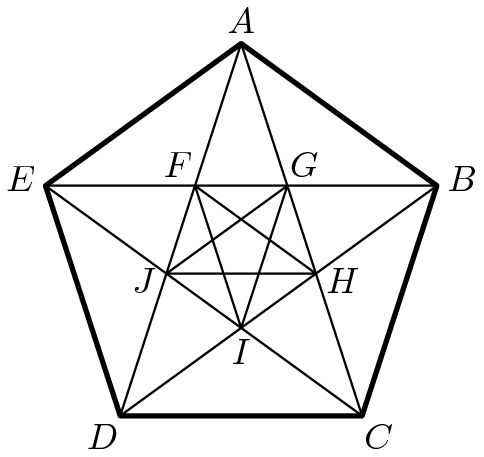
- A)
- B)
- C)
- D)
- E)
Answer
D
Key insight
Every small triangle is a golden triangle, so lengths are powers of phi: FG = 1/phi, JH = 1, CD = phi, summing to 2 phi.
Solution
Each interior angle is and each diagonal makes a angle with the adjacent sides, so every triangle in the figure has angles from . Let , so and . Standard fact: in a -- triangle, base (bisect a base angle to get a similar triangle: ).
and . In , , so . The reflection through 's axis of symmetry swaps and , hence , so as well.
. In , and , so it is -- with legs : . By symmetry the inner pentagon is regular with side , so too.
. . Triangle is -- with legs , so .
. and are non-adjacent vertices of the inner pentagon, so is its diagonal: .
Therefore
The answer is .
Why this works
A regular pentagon with its diagonals is built entirely from golden triangles, so every segment is the unit times a power of ; once one segment is known, the whole figure is known. The identity (and ) turns what looks like radical arithmetic into bookkeeping. Memorize: side diagonal, and the diagonals cut each other into pieces of length side and side.
The trap
Assuming G is the midpoint of AC, or misreading which points F, G, H, J are, e.g. treating JH as a side of the inner pentagon rather than a diagonal.
Common mistakes
- Assuming G is the midpoint of AC, or misreading which points F, G, H, J are, e.g. treating JH as a side of the inner pentagon rather than a diagonal.
- Using the wrong ratio for the -- triangle (base leg instead of leg), which scales every length the wrong way.
Techniques
Apply an identity: SFFT, sum of squares, difference of cubes, Vieta · Exploit symmetry to reduce work or pair up objects