2014 AMC 10A Problem 16
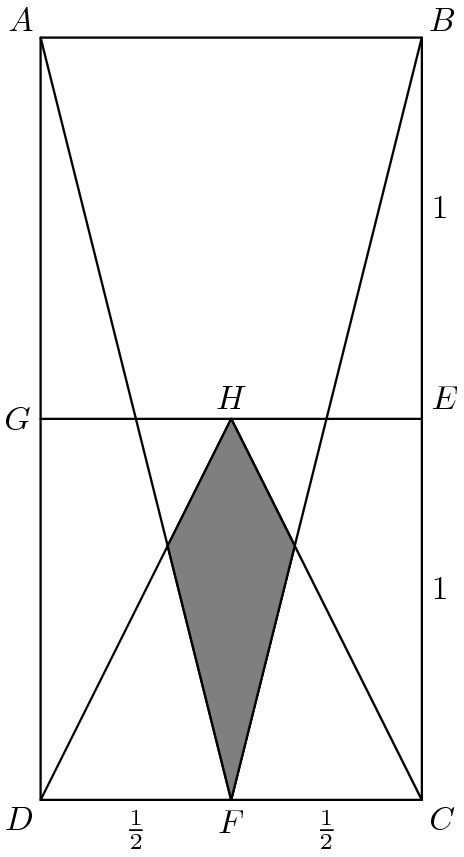
In rectangle , , , and points , , and are midpoints of , , and , respectively. Point is the midpoint of . What is the area of the shaded region?
Show solution without answering
Key insight
Put the rectangle on a grid. The shaded shape is a kite with a tall diagonal of length 1 and a crossing diagonal of length 1/3.
Solution
Every point in the picture is a corner or a midpoint, so coordinates will be small and easy. Put at the origin.
1. Coordinates. , , , . The midpoints are , , , and , the middle of , is .
2. The shape. The shaded region has top corner , bottom corner , and two side corners. The left side corner is where line crosses line . Call it .
3. Line . From to the line rises while moving across, so its slope is : .
4. Line . From down to it falls while moving across, so its slope is : .
5. Where they cross. Set . Then , so and . So .
6. The other side corner. The picture is the same on the left and right of the line , so the right side corner is .
7. Area. The line from to is straight up and down, with length . The line from to is flat, with length . These two diagonals are perpendicular, and a four-sided shape with perpendicular diagonals has area half their product:
The answer is .
Why this works
Figures full of midpoints in a rectangle are perfect for coordinates: each point has simple fractions as coordinates and each line has an easy equation. Using the left-right symmetry means you only find one crossing point. Seeing that the shape is a kite (perpendicular diagonals) makes the area one multiplication.
Alternative approach
Subtract triangles instead. Triangle has base and height , so its area is . The shaded kite is triangle with two triangles removed: on the left and on the right. Triangle has base and height (the height of ), so its area is . Triangle is its mirror image, also . So the shaded area is .
Concise solution
A shorter write-up, the way contest solutions are usually written. It may take a different route from the solution above.
Place , , , . Then , , and .
The shaded region is bounded by segments of , , , , with vertices (top), (bottom), and the two side corners and .
Line through and : . Line through and : . Solving gives , , so . By the left-right symmetry of the figure, .
The quadrilateral has perpendicular diagonals: is vertical with length , and is horizontal with length . Its area is half their product:
The answer is .
Review in the AoPS books
- Introduction to Geometry, Chapter 8: Quadrilaterals
- Introduction to Geometry, Chapter 3: Congruent Triangles
- Introduction to Geometry, Chapter 17: Analytic Geometry (§17.4, §17.6)
- Introduction to Algebra, Chapter 22: Special Manipulations (§22.3)
Similar problems
Problem © Mathematical Association of America (MAA), American Mathematics Competitions. Reproduced for non-commercial educational use. Solution and commentary are original to this site.