2006 AMC 10A Problem 17
In rectangle , points and trisect , and points and trisect . In addition, , and . What is the area of quadrilateral shown in the figure?
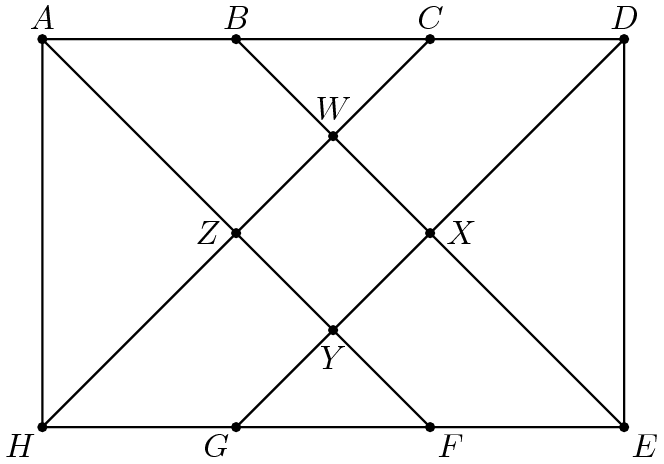
Show solution without answering
Key insight
Put the rectangle on a grid. Every drawn line has slope 1 or −1, so WXYZ is a square whose two diagonals both have length 1.
Solution
The figure is built on a small rectangle with evenly spaced points, so coordinates make every point easy to find.
1. Place the rectangle. Put at , at , at and at . The points on the top edge are and ; on the bottom edge, and .
2. The four lines. Each drawn segment goes across while going up or down, so its slope is or :
- : from to , so .
- : from to , so .
- : from to , so .
- : from to , so .
3. The four corners. Set the equations equal in pairs:
- and : , so . Point .
- and : , so . Point .
- and : , so . Point .
- and : , so . Point .
4. The shape. Lines with slopes and meet at right angles, so all four corners are right angles. The diagonal goes straight across from to : length . The diagonal goes straight down from to : length . Equal diagonals crossing at right angles in the middle make a square.
5. Area. A square (like any rhombus) has area half the product of its diagonals: .
The answer is .
Why this works
When a figure is a rectangle with equally spaced points, coordinates turn "find the inner shape" into a few short equations. Here the numbers were chosen so every line is at , which makes the corners land on halves. For a square tilted like a diamond, the diagonals are often easier to measure than the sides.
Alternative approach
The square's side is the distance between the parallel lines and . They are apart going straight across, and at the straight-across gap is the diagonal of a small square whose side is the true distance. So the side is and the area is .
Concise solution
A shorter write-up, the way contest solutions are usually written. It may take a different route from the solution above.
Place at the origin with , , . The trisection points are , on top and , on the bottom.
Each drawn segment rises or falls over a horizontal run of , so every one has slope :
Intersect pairs to locate the four vertices:
- : , so .
- : , so .
- : , so .
- : , so .
Lines of slope and are perpendicular, so is a rectangle, and by the left-right symmetry of the figure it is a square. Its diagonals are , horizontal from to with length , and , vertical from to with length . A square with diagonal has area .
The answer is .
Review in the AoPS books
- Introduction to Geometry, Chapter 8: Quadrilaterals
- Introduction to Geometry, Chapter 4: Perimeter and Area (§4.2)
- Introduction to Geometry, Chapter 17: Analytic Geometry (§17.4, §17.6)
- Introduction to Algebra, Chapter 22: Special Manipulations (§22.3)
Similar problems
Problem © Mathematical Association of America (MAA), American Mathematics Competitions. Reproduced for non-commercial educational use. Solution and commentary are original to this site.