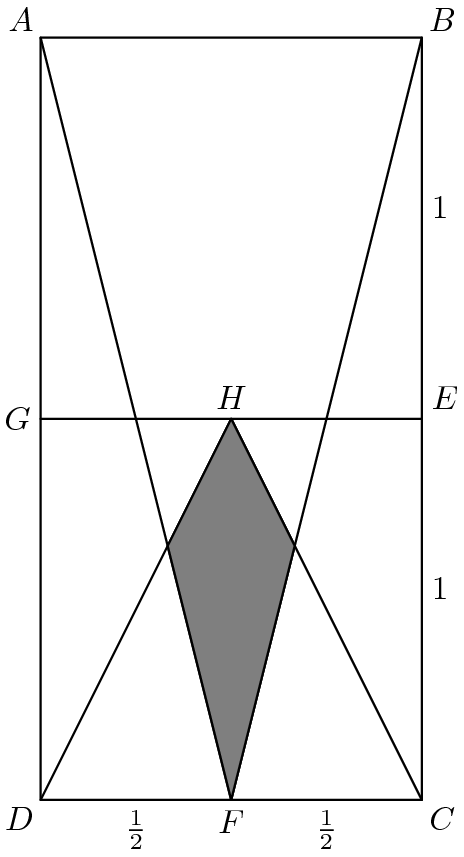
In rectangle , , , and points , , and are midpoints of , , and , respectively. Point is the midpoint of . What is the area of the shaded region?
- A)
- B)
- C)
- D)
- E)
Answer
E
Key insight
The shaded region is a kite with diagonal HF of length 1 along the vertical midline and a horizontal diagonal of length 1/3, so its area is (1/2)(1)(1/3).
Solution
Place , , , . Then , , and .
The shaded region is bounded by segments of , , , , with vertices (top), (bottom), and the two side corners and .
Line through and : . Line through and : . Solving gives , , so . By the left-right symmetry of the figure, .
The quadrilateral has perpendicular diagonals: is vertical with length , and is horizontal with length . Its area is half their product:
The answer is .
Why this works
Midpoint-heavy rectangle figures are ideal for coordinates: every relevant point has small rational coordinates and the bounding lines are easy to write. Symmetry about the vertical midline halves the work, and recognizing the region as a kite (perpendicular diagonals) turns the area into one multiplication instead of a shoelace computation.
Alternative approach
Synthetically: let be the foot of the perpendicular from to side . Right triangles and share the angle at , so ; right triangles and share the angle at , so . With this gives . Then the shaded kite is (area ) minus and (each ), leaving .
The trap
Assuming the side corners X and Y lie on the midline GE (height 1) instead of at height 2/3, which gives the wrong kite dimensions.
Common mistakes
- Assuming the side corners X and Y lie on the midline GE (height 1) instead of at height 2/3, which gives the wrong kite dimensions.
- Computing the kite's area as the full product of the diagonals, , or treating as a square.
Techniques
Place the figure on coordinates and compute · Exploit symmetry to reduce work or pair up objects