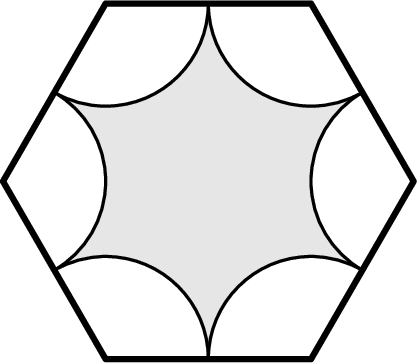
A regular hexagon has side length 6. Congruent arcs with radius 3 are drawn with the center at each of the vertices, creating circular sectors as shown. The region inside the hexagon but outside the sectors is shaded as shown. What is the area of the shaded region?
- A)
- B)
- C)
- D)
- E)
Answer
C
Key insight
Each sector spans the hexagon's 120-degree interior angle, so the six sectors total two full circles of radius 3; subtract 18 pi from the hexagon area 54 root 3.
Solution
Hexagon. A regular hexagon of side splits into six equilateral triangles of side , each of area . Total: .
Sectors. At each vertex the sector is bounded by the two sides meeting there, so its angle is the interior angle of the hexagon, , one third of a circle. Each sector has area . Six of them give . (Since the radius is half the side, neighboring sectors just touch at the midpoints of the sides and do not overlap.)
Shaded region. Subtract:
The answer is .
Why this works
"Inside the polygon, outside the sectors" is a subtraction of areas, and the only thing to get right is each sector's angle, which equals the polygon's interior angle at that vertex. A useful shortcut: the interior angles of any -gon total , so equal-radius sectors at every vertex always add up to full circles, here circles of radius .
The trap
Using 60 degrees for each sector (the central angle of a hexagon) instead of the 120-degree interior angle, giving 54 root 3 - 9 pi.
Common mistakes
- Using 60 degrees for each sector (the central angle of a hexagon) instead of the 120-degree interior angle, giving 54 root 3 - 9 pi.
- Computing the hexagon area with side or as with an arithmetic slip, landing on .
Techniques
Cut the figure into known shapes (triangles, rectangles, sectors)