2013 AMC 10A Problem 12
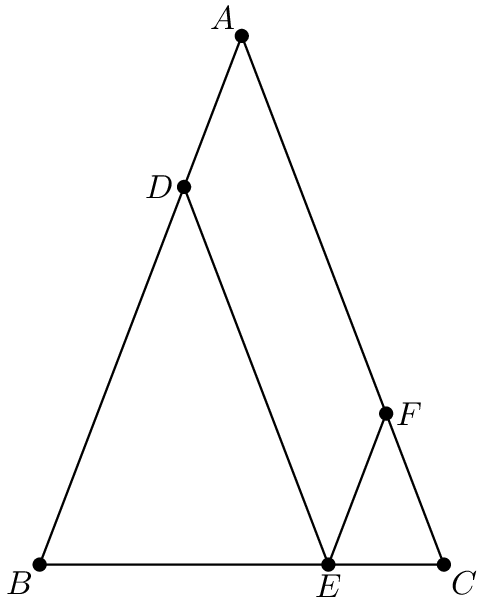
In , and . Points and are on sides , , and , respectively, such that and are parallel to and , respectively. What is the perimeter of parallelogram ?
Show solution without answering
Key insight
Parallel lines copy the equal base angles, so both small corner triangles are isosceles. Then the perimeter equals AB + AC.
Solution
The problem never says where is on . So the perimeter should be the same wherever is. Here is why.
1. Equal base angles. , so the triangle is isosceles and the angles at and are equal.
2. Look at the small triangle . is parallel to , so the angle equals the angle (corresponding angles). And angle equals angle . So triangle has two equal angles, at and at . That makes it isosceles: .
3. Look at the small triangle . In the same way, is parallel to , so angle equals angle , which equals angle . So .
4. Add up the sides of . Replace by and by :
5. is all of side , and is all of side . The perimeter is .
(The length is never needed.)
The answer is .
Why this works
Lines parallel to the sides of an isosceles triangle cut off smaller isosceles triangles. That lets you trade a slanted piece for an equal piece lying along a side. When a point can move freely and the question still has one answer, look for a trade like this.
Alternative approach
Since can be anywhere, put it at the middle of . Then and run from the middle of to the middles of and , so and are the midpoints of and . Each side of is half of , which is , and the perimeter is .
Concise solution
A shorter write-up, the way contest solutions are usually written. It may take a different route from the solution above.
Since , the base angles satisfy .
Because , the corresponding angles give . So triangle has two equal angles at and , making it isosceles with .
Likewise gives , so triangle is isosceles with .
Now add up the parallelogram's sides, replacing by and by :
The answer is .
Review in the AoPS books
- Introduction to Geometry, Chapter 3: Congruent Triangles
- Introduction to Geometry, Chapter 2: Angles
- Introduction to Geometry, Chapter 5: Similar Triangles
- Introduction to Geometry, Chapter 9: Polygons (§9.1, §9.2)
Similar problems
Problem © Mathematical Association of America (MAA), American Mathematics Competitions. Reproduced for non-commercial educational use. Solution and commentary are original to this site.