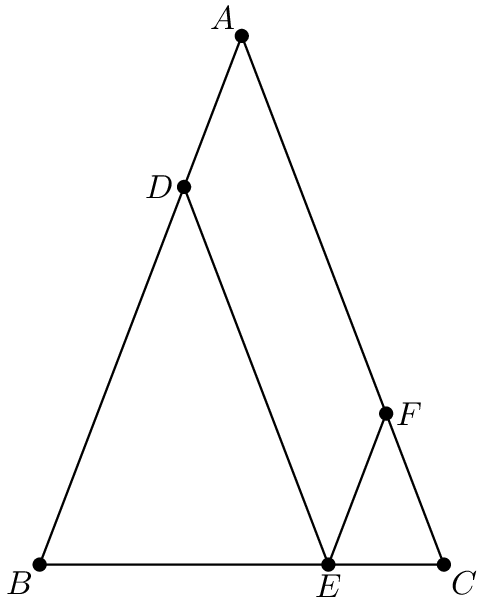
In , and . Points and are on sides , , and , respectively, such that and are parallel to and , respectively. What is the perimeter of parallelogram ?
- A)
- B)
- C)
- D)
- E)
Answer
C
Key insight
Parallel sides copy the base angles, so triangles DBE and FEC are isosceles: BD = DE and EF = FC, and the perimeter collapses to AB + AC.
Solution
Since , the base angles satisfy .
Because , the corresponding angles give . So triangle has two equal angles at and , making it isosceles with .
Likewise gives , so triangle is isosceles with .
Now add up the parallelogram's sides, replacing by and by :
The answer is .
Why this works
Lines parallel to the sides of an isosceles triangle cut off smaller isosceles triangles, which lets you trade a slanted segment for a segment along a side. The perimeter is then independent of the position of ; whenever a problem gives a movable point and asks for a fixed quantity, expect a trade like this. The length is never used.
Alternative approach
Since the answer cannot depend on , put at the midpoint of . Then and are the midpoints of and (midline theorem), and all four sides of equal , so the perimeter is .
The trap
Trying to locate E and compute lengths with similar-triangle ratios, when the answer does not depend on where E is.
Common mistakes
- Trying to locate E and compute lengths with similar-triangle ratios, when the answer does not depend on where E is.
- Using somewhere, for example answering .
Techniques
Set up the equation/formula and compute; no special trick needed