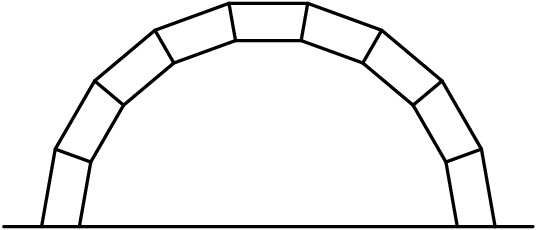
The keystone arch is an ancient architectural feature. It is composed of congruent isosceles trapezoids fitted together along the non-parallel sides, as shown. The bottom sides of the two end trapezoids are horizontal. In an arch made with trapezoids, let be the angle measure in degrees of the larger interior angle of the trapezoid. What is ?
- A)
- B)
- C)
- D)
- E)
Answer
A
Key insight
Extending all legs to the arch's center splits 180 degrees into nine 20-degree wedges, so each trapezoid's outer angles are 80 and inner angles 100.
Solution
Extend the non-parallel sides (legs) of every trapezoid downward. Since the trapezoids are congruent and glued leg to leg, all these lines pass through a single point on the ground line, the center of the arch. The arch spans a straight angle at , and the nine trapezoids divide it evenly, so each trapezoid sits inside a wedge of
Each trapezoid is an isosceles triangle with apex and apex angle , with its tip cut off by a line parallel to the base. The base angles of that triangle are ; these are the trapezoid's angles at its longer (outer) base.
The angles at the shorter (inner) base are supplementary to these, because the two bases are parallel: . That is the larger interior angle.
The answer is .
Why this works
Congruent pieces arranged around a point share a center; extending their edges reveals it and converts the arch into equal central wedges. Each trapezoid is then a triangle minus a similar tip, and all its angles follow from the wedge angle. Check with the end trapezoid: its bottom is horizontal and its outer leg makes with the ground, consistent with the picture.
The trap
Dividing 360 by 9 (a full circle) instead of 180 by 9, or reporting the smaller angle 80 or the wedge angle.
Common mistakes
- Dividing 360 by 9 (a full circle) instead of 180 by 9, or reporting the smaller angle 80 or the wedge angle.
- Treating the trapezoids as pieces of a regular -gon and mixing up interior and central angles.
Techniques
Add construction lines/points (drop altitudes, extend segments, connect centers) · Exploit symmetry to reduce work or pair up objects