2009 AMC 10B Problem 20
Triangle has a right angle at , , and . The angle bisector of intersects side at . What is ?
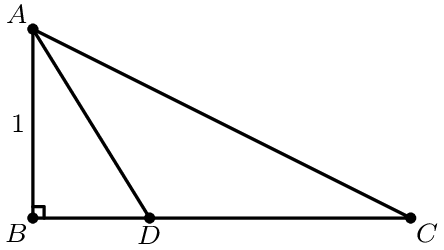
Show solution without answering
Key insight
An angle bisector splits the opposite side in the same ratio as the two sides that form the angle: here 1 to the square root of 5.
Solution
The angle bisector theorem is the standard tool here: it turns "this line cuts the angle in half" into a statement about lengths.
1. First find the third side. By the Pythagorean theorem, .
2. The angle bisector theorem says: the bisector from splits side into two pieces in the same ratio as the two sides that meet at . So
3. That means is cut into equal "shares," and gets of them. Since ,
4. The answers have no square root on the bottom, so multiply top and bottom by . On the bottom, :
5. Sense check: , so . That is less than half of , which makes sense because is the shorter of the two sides at .
The answer is .
Why this works
The angle bisector theorem turns an angle fact into a ratio of lengths. The ratio uses the two sides that form the bisected angle ( and ), not the side being cut. Once you have the ratio and the total length, splitting the side is one line of arithmetic.
Alternative approach
Drop a perpendicular from to and call its foot . Every point on the bisector is the same distance from both sides of the angle, so . Call this length . Triangles and are right triangles with the same slanted side and the same leg , so , and .
Now triangle has a right angle at and shares angle with triangle , so they have the same shape. In triangle the side across from is and the side next to is , so in triangle the side across from is half the side next to it:
Concise solution
A shorter write-up, the way contest solutions are usually written. It may take a different route from the solution above.
By the Pythagorean theorem, .
The bisector from divides the opposite side in the ratio of the adjacent sides:
Since , we get
Multiply numerator and denominator by :
Sanity check: , which is less than , consistent with .
The answer is .
Review in the AoPS books
- Introduction to Geometry, Chapter 7: Special Parts of a Triangle
- Introduction to Geometry, Chapter 4: Perimeter and Area (§4.2)
- Introduction to Geometry, Chapter 6: Right Triangles (§6.5)
- Introduction to Geometry, Chapter 10: Geometric Inequalities (§10.3)
Similar problems
Problem © Mathematical Association of America (MAA), American Mathematics Competitions. Reproduced for non-commercial educational use. Solution and commentary are original to this site.