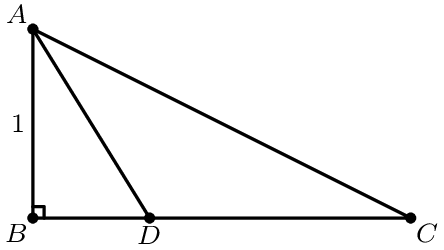
Triangle has a right angle at , , and . The angle bisector of intersects side at . What is ?
- A)
- B)
- C)
- D)
- E)
Answer
B
Key insight
The angle bisector theorem gives BD : DC = AB : AC = 1 : sqrt5, so BD = 2/(1 + sqrt5), which rationalizes to (sqrt5 - 1)/2.
Solution
By the Pythagorean theorem, .
The bisector from divides the opposite side in the ratio of the adjacent sides:
Since , we get
Multiply numerator and denominator by :
Sanity check: , which is less than , consistent with .
The answer is .
Why this works
The angle bisector theorem converts an angle condition into a length ratio, and the ratio uses the two sides that form the bisected angle. Combined with the known total of the split side, it is a one-line computation; the only care needed is rationalizing to match the answer format.
Alternative approach
Let , so . From with , and ; then .
The trap
Splitting BC in the ratio of the legs AB : BC = 1 : 2 instead of AB : AC, which gives BD = 2/3.
Common mistakes
- Splitting BC in the ratio of the legs AB : BC = 1 : 2 instead of AB : AC, which gives BD = 2/3.
- Writing the ratio upside down and obtaining instead of , i.e. choice (C) after rationalizing.
Techniques
Set up the equation/formula and compute; no special trick needed