2009 AMC 10A Problem 21
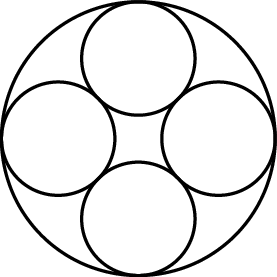
Many Gothic cathedrals have windows with portions containing a ring of congruent circles that are circumscribed by a larger circle. In the figure shown, the number of smaller circles is four. What is the ratio of the sum of the areas of the four smaller circles to the area of the larger circle?
Show solution without answering
Key insight
The four small centers form a square of side 2r. The big center is half a diagonal, r times root 2, from each, so R = r(1 + root 2).
Solution
Call the radius of each small circle and the radius of the big circle . Let be the center of the big circle.
1. Neighboring small circles touch, so their centers are apart. The four small centers form a square with side , and is at the middle of this square.
2. The diagonal of a square with side is (Pythagorean theorem: ). The distance from to a small center is half of it, .
3. Each small circle touches the big circle from inside. Go from to a small center (), then keep going outward one more small radius () to reach the big circle:
4. The ratio of areas:
5. Expand: .
6. To clear the square root from the bottom, use . Multiply top and bottom by :
The answer is .
Why this works
For circles that touch, connect their centers. Touching circles have centers exactly the sum of their radii apart (or the difference, if one is inside the other). Here the four centers make a square, and the square's diagonal gives the length you need.
Alternative approach
Estimate. Take , so and . The ratio is about . The choices are about (A) , (B) , (C) , (D) and (E) , so only (C) fits.
Concise solution
A shorter write-up, the way contest solutions are usually written. It may take a different route from the solution above.
Let the small circles have radius and the large circle radius , with center .
Connect the centers of the four small circles. Adjacent small circles are tangent, so neighboring centers are apart, and the four centers form a square of side centered at . The distance from to any small center is half the square's diagonal:
Each small circle is internally tangent to the big circle, so equals the distance from to a small center plus :
The requested ratio is
Rationalize with (note ):
The answer is .
Review in the AoPS books
- Introduction to Geometry, Chapter 11: Circles
- Introduction to Geometry, Chapter 8: Quadrilaterals
- Introduction to Geometry, Chapter 19: Problem Solving Strategies in Geometry (§19.1)
- Introduction to Geometry, Chapter 12: Circles and Angles
Similar problems
Problem © Mathematical Association of America (MAA), American Mathematics Competitions. Reproduced for non-commercial educational use. Solution and commentary are original to this site.