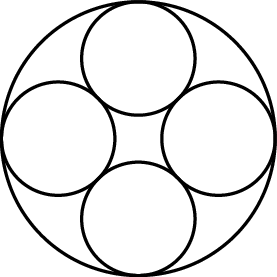
Many Gothic cathedrals have windows with portions containing a ring of congruent circles that are circumscribed by a larger circle. In the figure shown, the number of smaller circles is four. What is the ratio of the sum of the areas of the four smaller circles to the area of the larger circle?
- A)
- B)
- C)
- D)
- E)
Answer
C
Key insight
The four small centers form a square of side 2r, so each is r sqrt 2 from the big center and the big radius is r(1 + sqrt 2).
Solution
Let the small circles have radius and the large circle radius , with center .
Connect the centers of the four small circles. Adjacent small circles are tangent, so neighboring centers are apart, and the four centers form a square of side centered at . The distance from to any small center is half the square's diagonal:
Each small circle is internally tangent to the big circle, so equals the distance from to a small center plus :
The requested ratio is
Rationalize with (note ):
The answer is .
Why this works
Tangency problems are solved by connecting centers: tangent circles have centers separated by the sum (external) or difference (internal) of their radii. The ring of four turns into a square, whose diagonal supplies the key length. Recognizing and its conjugate makes the final simplification instant.
Alternative approach
Set and estimate: , so the ratio is . Among the choices, only (C) fits; (A) is (the ratio for one small circle) and (B), (E) are , .
The trap
Taking the distance from the big center to a small center as 2r or r instead of half the square's diagonal, r sqrt 2.
Common mistakes
- Taking the distance from the big center to a small center as 2r or r instead of half the square's diagonal, r sqrt 2.
- Comparing only one small circle to the large one and answering , choice (A).
Techniques
Add construction lines/points (drop altitudes, extend segments, connect centers) · Set up the equation/formula and compute; no special trick needed