2009 AMC 10A Problem 10
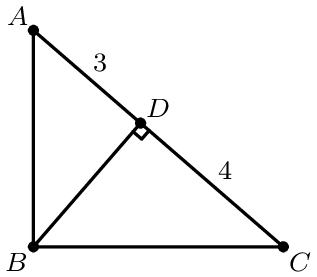
Triangle has a right angle at . Point is the foot of the altitude from , , and . What is the area of ?
Show solution without answering
Key insight
The height BD is a leg of two small right triangles. Using the Pythagorean theorem in all three triangles gives BD squared = 3 x 4 = 12.
Solution
The area of a triangle is half of base times height. Take as the base: . The height to that base is . So we only need . Call it .
1. Triangle has a right angle at , with legs and . By the Pythagorean theorem,
2. Triangle also has a right angle at , with legs and :
3. The big triangle has a right angle at , and its long side is :
4. Put steps 1 and 2 into step 3:
5. So .
6. Area:
The answer is .
Why this works
Drawing the height from the right angle splits the triangle into two smaller right triangles, and the Pythagorean theorem works in all three. Writing all three equations and adding makes the unknown sides drop out. The result is a fact worth remembering: the height to the long side, squared, equals the product of the two pieces it cuts ().
Alternative approach
Use similar triangles. The small triangles and both have a right angle at , and (each one plus makes ). So they are similar, and matching sides gives
Then and the area is .
Concise solution
A shorter write-up, the way contest solutions are usually written. It may take a different route from the solution above.
The altitude from the right angle splits into two triangles, and , each similar to the original. In particular (both right-angled, and since each is complementary to ). Matching legs,
so .
The hypotenuse is and is the altitude to it, so
The answer is .
Review in the AoPS books
- Introduction to Geometry, Chapter 3: Congruent Triangles
- Introduction to Geometry, Chapter 4: Perimeter and Area (§4.2)
- Introduction to Geometry, Chapter 5: Similar Triangles
- Introduction to Geometry, Chapter 6: Right Triangles (§6.1, §6.2, §6.3)
Similar problems
Problem © Mathematical Association of America (MAA), American Mathematics Competitions. Reproduced for non-commercial educational use. Solution and commentary are original to this site.