2008 AMC 10A Problem 25
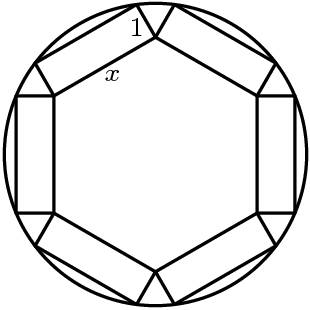
A round table has radius . Six rectangular place mats are placed on the table. Each place mat has width and length as shown. They are positioned so that each mat has two corners on the edge of the table, these two corners being end points of the same side of length . Furthermore, the mats are positioned so that the inner corners each touch an inner corner of an adjacent mat. What is ?
Show solution without answering
Key insight
The touching inner corners form a regular hexagon with side x, so the inner edge is known from the center; one right triangle to the table edge gives x.
Solution
Let be the center of the table. Focus on one mat, with outer corners and on the table's edge and inner corners and . So and .
1. The inner corners. Each inner corner touches an inner corner of the next mat, so there are meeting points around the center, evenly spaced. They form a regular hexagon, and is one of its sides.
2. A regular hexagon splits into equilateral triangles meeting at the center. So triangle is equilateral with side .
3. Distance from to the inner edge. The height of an equilateral triangle with side is . So the inner edge is from .
4. Distance from to the outer edge. The mat is unit wide, and the outer edge is parallel to and farther out. So is from .
5. One right triangle. Let be the midpoint of . Then , , and because is on the table's edge. The angle at is a right angle, so by the Pythagorean theorem
6. Solve. Multiply out: , which simplifies to
The quadratic formula gives the positive solution
The answer is .
Why this works
When identical pieces are arranged evenly around a center, look for the regular polygon formed by the points where they touch. Here it is a hexagon, and a regular hexagon's side equals its distance from center to corner. That tells you how far one mat sits from the center, and then a single right triangle finishes the job.
Alternative approach
Check the answer with estimates. and , so choice (C) is about . Put into step 5: and , and , very close to . Choice (B), , gives , too small, so (C) is the one that fits.
Concise solution
A shorter write-up, the way contest solutions are usually written. It may take a different route from the solution above.
Let be the table's center. Take one mat with outer corners on the circle and inner corners , so and .
By the six-fold symmetry, the six inner corners (each shared by two adjacent mats) form a regular hexagon centered at , and is one of its sides. A regular hexagon's circumradius equals its side, so and is equilateral. Its height is the distance from to the inner edge :
The outer edge is parallel to and unit farther from , so . Let be the midpoint of ; then and . Pythagoras in :
Expanding, , so
The answer is .
Review in the AoPS books
- Introduction to Geometry, Chapter 11: Circles
- Introduction to Geometry, Chapter 2: Angles
- Introduction to Algebra, Chapter 10: Quadratic Equations – Part 1 (§10.2, §10.3, §10.4)
- Introduction to Algebra, Chapter 22: Special Manipulations (§22.3)
Similar problems
Problem © Mathematical Association of America (MAA), American Mathematics Competitions. Reproduced for non-commercial educational use. Solution and commentary are original to this site.