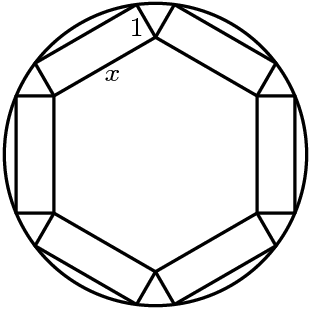
A round table has radius . Six rectangular place mats are placed on the table. Each place mat has width and length as shown. They are positioned so that each mat has two corners on the edge of the table, these two corners being end points of the same side of length . Furthermore, the mats are positioned so that the inner corners each touch an inner corner of an adjacent mat. What is ?
- A)
- B)
- C)
- D)
- E)
Answer
C
Key insight
The six inner corners form a regular hexagon with side x, so the inner edge is x sqrt(3)/2 from the center; add 1 and apply Pythagoras.
Solution
Let be the table's center. Take one mat with outer corners on the circle and inner corners , so and .
By the six-fold symmetry, the six inner corners (each shared by two adjacent mats) form a regular hexagon centered at , and is one of its sides. A regular hexagon's circumradius equals its side, so and is equilateral. Its height is the distance from to the inner edge :
The outer edge is parallel to and unit farther from , so . Let be the midpoint of ; then and . Pythagoras in :
Expanding, , so
The answer is .
Why this works
Rotational symmetry converts "inner corners touch" into a regular hexagon, and the hexagon's side-equals-radius property turns the unknown into a distance from the center. Once one mat is described by a distance-to-chord picture, everything reduces to one right triangle. The lesson: in symmetric arrangements, identify the regular polygon hiding in the contact points, then work with a single representative piece.
Alternative approach
Coordinates: put and as adjacent hexagon vertices, so the outer corner is . Setting gives the same quadratic. Numerically , which rules out (B) and (D) once you trust the equation.
The trap
Assuming the inner corners lie on a circle of radius 3 (the table radius minus the mat width), rather than at distance x from the center.
Common mistakes
- Assuming the inner corners lie on a circle of radius 3 (the table radius minus the mat width), rather than at distance x from the center.
- Sign error when solving the quadratic, e.g. taking , or dropping the cross term from the expansion.
Techniques
Add construction lines/points (drop altitudes, extend segments, connect centers) · Exploit symmetry to reduce work or pair up objects