2006 AMC 10B Problem 8
A square of area 40 is inscribed in a semicircle as shown. What is the area of the semicircle?
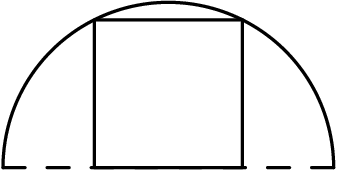
Show solution without answering
Key insight
A line from the center to a top corner is a radius: the long side of a right triangle with legs equal to the side and half the side.
Solution
1. Let the square's side be . Its area is , so . We will not need itself, only .
2. The square sits on the flat edge of the semicircle, right in the middle. So the center of the semicircle is at the midpoint of the square's bottom side, and each bottom corner is away from .
3. The top corners of the square touch the curved arc. So the segment from to a top corner is a radius .
4. That segment is the long side of a right triangle. Go from sideways to a bottom corner, then straight up to the top corner. By the Pythagorean theorem,
5. A semicircle is half a circle, so its area is
The answer is .
Why this works
When a shape is drawn inside a circle with its corners on the curve, a line from the center to a corner is a radius. That line usually forms a right triangle with the shape's sides, so the Pythagorean theorem gives the radius. Here it helps to keep working with instead of finding ; the square roots never appear.
Concise solution
A shorter write-up, the way contest solutions are usually written. It may take a different route from the solution above.
Let the side of the square be , so . The square's base sits on the diameter and, by symmetry, is centered at the semicircle's center . So is from each bottom corner.
Draw the segment from to an upper corner of the square; that corner is on the arc, so the segment is a radius . It is the hypotenuse of a right triangle with horizontal leg and vertical leg :
The semicircle's area is .
The answer is .
Review in the AoPS books
- Introduction to Geometry, Chapter 11: Circles
- Introduction to Geometry, Chapter 4: Perimeter and Area (§4.2)
- Introduction to Geometry, Chapter 19: Problem Solving Strategies in Geometry (§19.1)
- Introduction to Geometry, Chapter 12: Circles and Angles
Similar problems
Problem © Mathematical Association of America (MAA), American Mathematics Competitions. Reproduced for non-commercial educational use. Solution and commentary are original to this site.