A square of area 40 is inscribed in a semicircle as shown. What is the area of the semicircle?
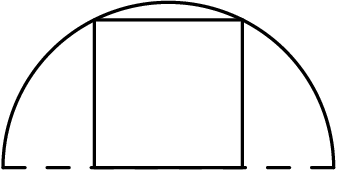
- A)
- B)
- C)
- D)
- E)
Answer
B
Key insight
Join the center to a top corner of the square: the radius is the hypotenuse of a right triangle with legs s and s/2, so r^2 = (5/4)s^2 = 50.
Solution
Let the side of the square be , so . The square's base sits on the diameter and, by symmetry, is centered at the semicircle's center . So is from each bottom corner.
Draw the segment from to an upper corner of the square; that corner is on the arc, so the segment is a radius . It is the hypotenuse of a right triangle with horizontal leg and vertical leg :
The semicircle's area is .
The answer is .
Why this works
"Inscribed" means the square's vertices touch the arc, so a radius drawn to a vertex creates a right triangle with the square's sides. Working with throughout, never itself, keeps the square root of out of the computation entirely.
The trap
Taking the square's side as the radius (r^2 = 40) or as the diameter, giving 20 pi or 5 pi.
Common mistakes
- Taking the square's side as the radius (r^2 = 40) or as the diameter, giving 20 pi or 5 pi.
- Reporting the full circle's area (choice (E)) instead of the semicircle's.
Techniques
Add construction lines/points (drop altitudes, extend segments, connect centers) · Set up the equation/formula and compute; no special trick needed