2005 AMC 10A Problem 23
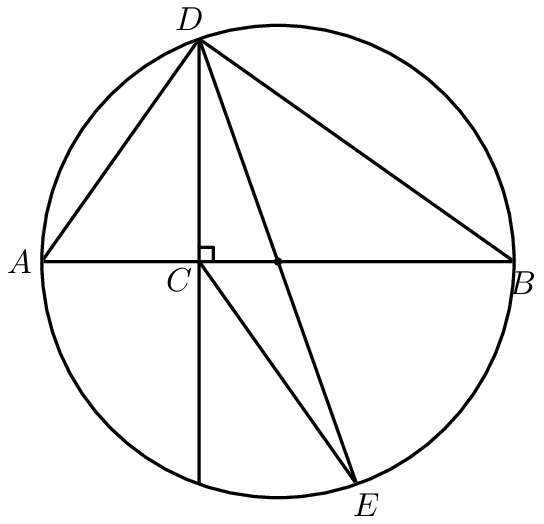
Let be a diameter of a circle and be a point on with . Let and be points on the circle such that and is a second diameter. What is the ratio of the area of to the area of ?
Show solution without answering
Key insight
O is the midpoint of DE, so triangle DCE is twice triangle DCO. Triangles DCO and ABD share the height DC, so compare their bases CO and AB.
Solution
Pick easy numbers. Since is twice , let and . Then the diameter , the radius is , and the center is from . So is between and , with .
1. Split triangle at . Both diameters pass through the center, so is the midpoint of . The segment splits triangle into two triangles, and . They have equal bases () and the same height from , so they have equal areas. Therefore
2. Compare triangle with triangle . Both have their base on line : base for one and base for the other. Both have their top at . Since is perpendicular to , both have the same height, . Triangles with the same height compare by their bases:
3. Put the two steps together.
The answer is .
Why this works
Area ratios rarely need actual lengths. Two tools did all the work: a line from a corner to the middle of the opposite side cuts a triangle into two equal halves, and triangles with the same height compare by their bases. The length of was never needed because it appears in both areas and cancels.
Alternative approach
Compute every area. With and , in right triangle the hypotenuse is the radius and one leg is , so . Then the area of is . The area of is , so the area of is . The ratio is .
Concise solution
A shorter write-up, the way contest solutions are usually written. It may take a different route from the solution above.
Let be the center. Scale so that and ; then , the radius is , and .
Step 1: Both diameters pass through , so is the midpoint of . In the segment is a median, and a median splits a triangle into two pieces of equal area. Hence
Step 2: Triangles and both have a base on line ( and respectively) and share the same apex , so both have height . Their areas are in the ratio of their bases:
Combining,
The answer is .
Review in the AoPS books
- Introduction to Geometry, Chapter 11: Circles
- Introduction to Geometry, Chapter 4: Perimeter and Area (§4.2)
- Introduction to Algebra, Chapter 22: Special Manipulations (§22.3)
- Introduction to Geometry, Chapter 12: Circles and Angles
Similar problems
Problem © Mathematical Association of America (MAA), American Mathematics Competitions. Reproduced for non-commercial educational use. Solution and commentary are original to this site.