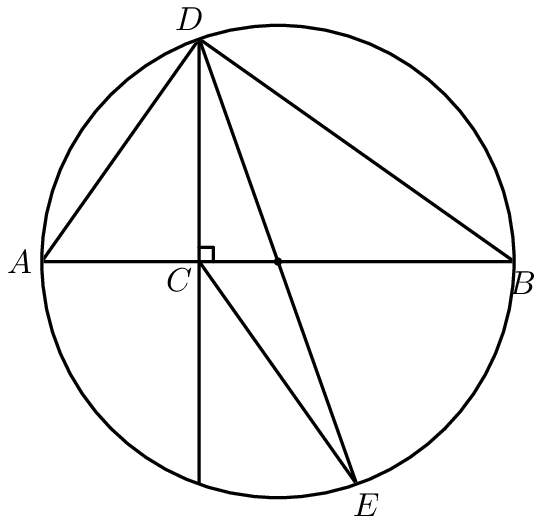
Let be a diameter of a circle and be a point on with . Let and be points on the circle such that and is a second diameter. What is the ratio of the area of to the area of ?
- A)
- B)
- C)
- D)
- E)
Answer
C
Key insight
O is the midpoint of DE, so [DCE] = 2[DCO], and triangles DCO and ABD share the height DC with bases CO and AB in ratio 1:6.
Solution
Let be the center. Scale so that and ; then , the radius is , and .
Step 1: Both diameters pass through , so is the midpoint of . In the segment is a median, and a median splits a triangle into two pieces of equal area. Hence
Step 2: Triangles and both have a base on line ( and respectively) and share the same apex , so both have height . Their areas are in the ratio of their bases:
Combining,
The answer is .
Why this works
Area ratios rarely need actual lengths. Two tools do the work: a median halves area, and triangles sharing an altitude compare by base. The right angle at and the value of are red herrings; only the positions and along the diameter matter, which is why the answer is a clean .
Alternative approach
Compute: , so and . In right triangle (legs and , hypotenuse ) the altitude from to is , so . Ratio .
The trap
Computing DC via power of a point and then working out the altitude from C to DE with messy radicals, instead of comparing triangles that share the altitude DC.
Common mistakes
- Computing DC via power of a point and then working out the altitude from C to DE with messy radicals, instead of comparing triangles that share the altitude DC.
- Placing at of the radius rather than of the diameter, which changes and produces or .
Techniques
Cut the figure into known shapes (triangles, rectangles, sectors) · Exploit symmetry to reduce work or pair up objects