2005 AMC 10A Problem 17
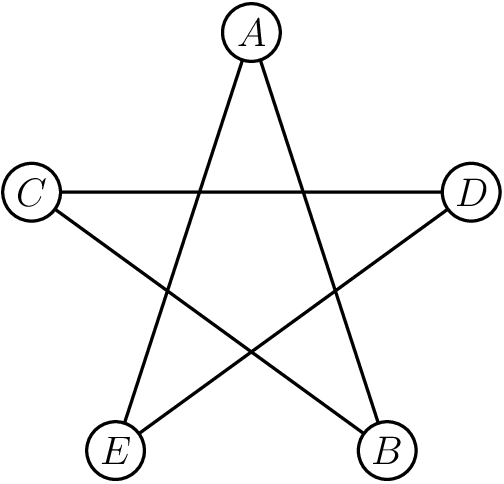
In the five-sided star shown, the letters , , , , and are replaced by the numbers , , , , and , although not necessarily in this order. The sums of the numbers at the ends of the line segments , , , , and form an arithmetic sequence, although not necessarily in this order. What is the middle term of the arithmetic sequence?
Show solution without answering
Key insight
Each letter is on exactly two segments, so the five sums add to twice 30, which is 60. The middle of five evenly spaced numbers is their average, 12.
Solution
You do not need to find where each number goes. Add up all five sums instead.
1. Each letter is used twice. The segments go to , to , to , to , and back to . Every letter is at the end of exactly two of them. For example, is on and .
2. Total of the five sums. Since each number is counted twice,
3. Middle term of an arithmetic sequence. In five evenly spaced numbers, the middle one is the average. For example, has average , the middle term. The terms below and above the middle balance out.
4. Compute. The average of the five sums is .
It is possible to do this: , , , , gives sums , which sort to .
The answer is .
Why this works
Two ideas work together. First, when every number is used in exactly two sums, the sums together add to twice the numbers. Second, in an arithmetic sequence with an odd number of terms, the middle term equals the average. Neither idea needs the arrangement, which is why the problem says "not necessarily in this order."
Concise solution
A shorter write-up, the way contest solutions are usually written. It may take a different route from the solution above.
The five segments form a closed loop through the five letters, so each letter is an endpoint of exactly two segments. Adding up all five segment sums therefore counts every vertex value twice:
In an arithmetic sequence with an odd number of terms, the terms are symmetric about the middle one, so the middle term equals the average of all terms:
(An assignment does exist, e.g. gives sums , the sequence .)
The answer is .
Review in the AoPS books
- Introduction to Algebra, Chapter 21: Sequences & Series (§21.1, §21.2, §21.3, §21.4)
- Introduction to Algebra, Chapter 22: Special Manipulations (§22.3)
- Intermediate Algebra, Chapter 17: More Sequences and Series (§17.1, §17.2)
- Introduction to Counting & Probability, Chapter 3: Correcting for Overcounting (§3.4)
Similar problems
Problem © Mathematical Association of America (MAA), American Mathematics Competitions. Reproduced for non-commercial educational use. Solution and commentary are original to this site.