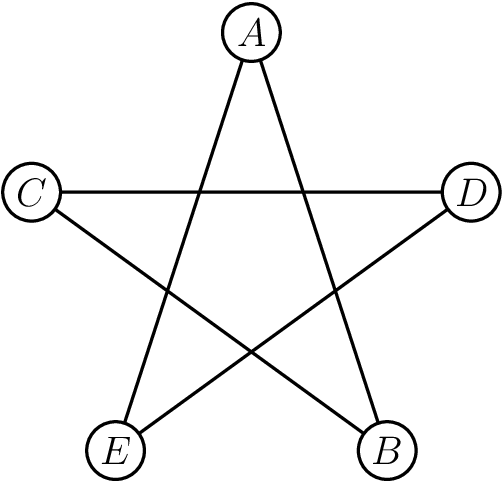
In the five-sided star shown, the letters , , , , and are replaced by the numbers , , , , and , although not necessarily in this order. The sums of the numbers at the ends of the line segments , , , , and form an arithmetic sequence, although not necessarily in this order. What is the middle term of the arithmetic sequence?
- A)
- B)
- C)
- D)
- E)
Answer
D
Key insight
Every vertex lies on exactly two segments, so the five sums total 2(3+5+6+7+9) = 60, and the middle term of five in arithmetic progression is their average, 12.
Solution
The five segments form a closed loop through the five letters, so each letter is an endpoint of exactly two segments. Adding up all five segment sums therefore counts every vertex value twice:
In an arithmetic sequence with an odd number of terms, the terms are symmetric about the middle one, so the middle term equals the average of all terms:
(An assignment does exist, e.g. gives sums , the sequence .)
The answer is .
Why this works
Two ideas combine: double counting (a quantity summed over edges can be re-summed over vertices) and the fact that the mean of an arithmetic sequence is its middle term. Neither requires knowing the arrangement, which is why the problem says "not necessarily in this order" twice: the order is irrelevant.
The trap
Trying to find the actual assignment of numbers to vertices by trial and error instead of using the double-counting shortcut.
Common mistakes
- Trying to find the actual assignment of numbers to vertices by trial and error instead of using the double-counting shortcut.
- Dividing the vertex total by to get , forgetting that each segment sum involves two vertices.
Techniques
Set up the equation/formula and compute; no special trick needed · Exploit symmetry to reduce work or pair up objects