2004 AMC 10B Problem 12
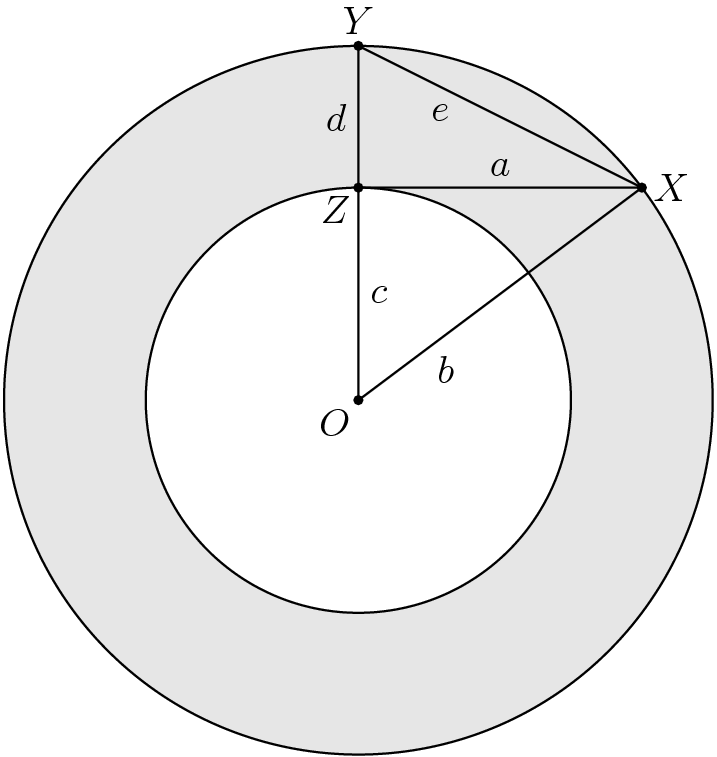
An annulus is the region between two concentric circles. The concentric circles in the figure have radii and , with . Let be a radius of the larger circle, let be tangent to the smaller circle at , and let be the radius of the larger circle that contains . Let , , and . What is the area of the annulus?
Show solution without answering
Key insight
A radius meets a tangent line at a right angle, so triangle OZX is a right triangle. The Pythagorean theorem gives b squared minus c squared equals a squared.
Solution
1. The ring (annulus) is the big disk with the small disk cut out. Its area is
So we need to connect to one of the lengths .
2. Look for a right triangle, since squares of lengths suggest the Pythagorean theorem. touches the small circle at (it is tangent there), and is a radius of the small circle. A radius always meets a tangent line at a right angle, so the angle at in triangle is .
3. In that right triangle, the legs are and , and the longest side is (a radius of the big circle). So
4. The area of the ring is .
The answer is .
Why this works
"Radius meets tangent at a right angle" is the standard way to find a right triangle inside a circle problem. The area of a ring is times a difference of two squares, and a right triangle is exactly what turns a difference of squares into one square. The lengths and are in the picture only to tempt you.
Alternative approach
Test an extreme case. Let the small circle shrink to a point, so . Then the ring is the whole big disk, with area . Also lands on , so . Choice (A) gives , which matches. This is a quick check; the right-triangle argument is what proves it for every size.
Concise solution
A shorter write-up, the way contest solutions are usually written. It may take a different route from the solution above.
The annulus is the big disk minus the small disk, so its area is
Now relate to the labeled segments. is tangent to the small circle at , and is a radius of that circle, so . Triangle is therefore right-angled at with legs and and hypotenuse . The Pythagorean theorem gives
Hence the annulus has area .
The answer is .
Review in the AoPS books
- Introduction to Geometry, Chapter 11: Circles
- Introduction to Geometry, Chapter 4: Perimeter and Area (§4.2)
- Introduction to Geometry, Chapter 12: Circles and Angles
- Introduction to Geometry, Chapter 6: Right Triangles (§6.1, §6.2, §6.3)
Similar problems
Problem © Mathematical Association of America (MAA), American Mathematics Competitions. Reproduced for non-commercial educational use. Solution and commentary are original to this site. Also appeared as 2004 12B #10.