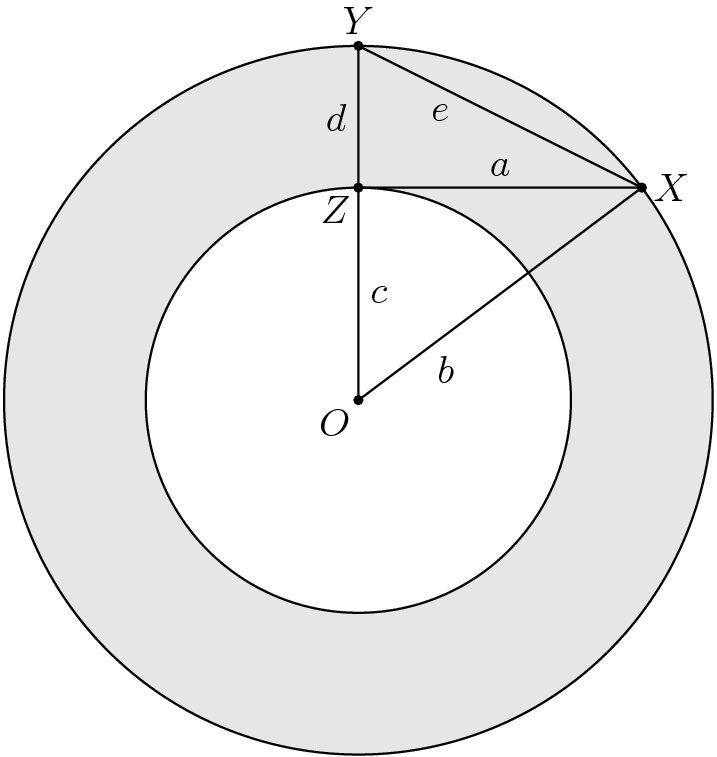
An annulus is the region between two concentric circles. The concentric circles in the figure have radii and , with . Let be a radius of the larger circle, let be tangent to the smaller circle at , and let be the radius of the larger circle that contains . Let , , and . What is the area of the annulus?
- A)
- B)
- C)
- D)
- E)
Answer
A
Key insight
A radius meets a tangent at a right angle, so a^2 + c^2 = b^2 and the annulus area pi(b^2 - c^2) equals pi a^2.
Solution
The annulus is the big disk minus the small disk, so its area is
Now relate to the labeled segments. is tangent to the small circle at , and is a radius of that circle, so . Triangle is therefore right-angled at with legs and and hypotenuse . The Pythagorean theorem gives
Hence the annulus has area .
The answer is .
Why this works
The "tangent is perpendicular to the radius" fact is the standard way to manufacture a right triangle inside a circle problem, and is exactly the difference of squares that a right triangle produces. The distractors and are real lengths in the figure but have no simple relation to the area; the tangent segment is the one tied to both radii at once.
Alternative approach
Sanity check with extremes: if grows toward , the annulus shrinks to nothing, and so do , , and , ruling out (B) and (C). Sending to instead turns the annulus into the whole disk and makes , so and (A) gives the right area, while would make (D) and (E) plausible too; only the Pythagorean relation settles it in general.
The trap
Missing the right angle at Z (radius perpendicular to tangent) and trying to build the answer from the segments d or e instead.
Common mistakes
- Missing the right angle at Z (radius perpendicular to tangent) and trying to build the answer from the segments d or e instead.
- Writing the Pythagorean relation as , treating as the hypotenuse.
Techniques
Use the answer choices (mod checks, size, form) to eliminate or select · Set up the equation/formula and compute; no special trick needed