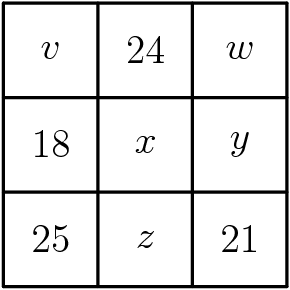
In the magic square shown, the sums of the numbers in each row, column, and diagonal are the same. Five of these numbers are represented by , , , , and . Find .
- A)
- B)
- C)
- D)
- E)
Answer
D
Key insight
Compare lines that share an unknown: left column versus main diagonal gives x = 22, top row versus left column gives w = 19 and the magic sum 66.
Solution
The square, row by row, is
Let be the common sum.
The left column and the main diagonal both contain : , so .
The top row and the left column both contain : , so . Now the other diagonal gives .
Bottom row: , so . Middle row: , so . (Then , and every line checks.)
Hence .
The answer is .
Why this works
A magic square gives eight linear equations in six unknowns (five letters and the sum), far more than needed. The efficient move is to subtract two lines that share a letter so that letter and both disappear, producing a numeric value at once. Two such pairings plus one line to fix finish the problem.
Alternative approach
In any magic square the center equals (add the middle row, middle column and both diagonals: ). With , , and the middle row and column give and directly.
The trap
Writing all eight equations and solving blindly; instead pair lines that share a variable so the unknown cancels immediately.
Common mistakes
- Writing all eight equations and solving blindly; instead pair lines that share a variable so the unknown cancels immediately.
- Answering by luck of the setup but computing wrongly, or reporting or alone.
Techniques
Set up the equation/formula and compute; no special trick needed