2001 AMC 10 Problem 11
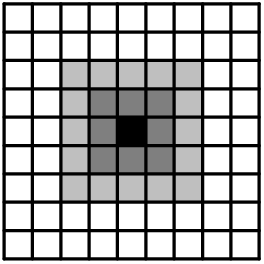
Consider the dark square in an array of unit squares, part of which is shown. The first ring of squares around this center square contains unit squares. The second ring contains unit squares. If we continue this process, the number of unit squares in the ring is
Show solution without answering
Key insight
Split a ring into its four sides. The nth ring has two rows of 2n+1 squares and two columns of 2n-1 squares, which adds up to 8n.
Solution
1. Start with the rings you can see. The center square is . With the first ring it becomes a square; with the second ring, a square. Each ring adds one square on every side, so the side grows by .
2. So the th ring is the border of a square with side . For the th ring that is a square, and we only want its border.
3. Count the border in four pieces, making sure each corner is counted once:
- the top row: all squares, corners included;
- the bottom row: also squares;
- the left column without its two corners: squares;
- the right column without its two corners: squares.
4. Add: .
5. Check with the given rings: gives and gives . Both match.
6. For the th ring: .
The answer is .
Why this works
A ring is just the edge of a square, so its size depends on the side length, not the area. The rings grow steadily (), adding each time, even though the full squares grow much faster. When counting the edge of a square, be careful to count each corner exactly once.
Alternative approach
Subtract areas. The th ring is the square with the square inside it removed. For : . (A faster way to compute this: .)
Concise solution
A shorter write-up, the way contest solutions are usually written. It may take a different route from the solution above.
The center square together with the first rings forms a solid square of side (one ring adds one unit on each side). The th ring alone is that square with the side- square removed:
Check against the given data: gives and gives .
For the ring contains unit squares.
The answer is .
Review in the AoPS books
- Introduction to Algebra, Chapter 21: Sequences & Series (§21.1, §21.2, §21.3, §21.4)
- Introduction to Counting & Probability, Chapter 1: Counting Is Arithmetic
- Prealgebra, Chapter 15: Problem-Solving Strategies (§15.1)
- Introduction to Algebra, Chapter 11: Special Factorizations
Similar problems
Problem © Mathematical Association of America (MAA), American Mathematics Competitions. Reproduced for non-commercial educational use. Solution and commentary are original to this site.