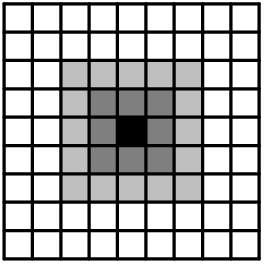
Consider the dark square in an array of unit squares, part of which is shown. The first ring of squares around this center square contains unit squares. The second ring contains unit squares. If we continue this process, the number of unit squares in the ring is
- A)
- B)
- C)
- D)
- E)
Answer
C
Key insight
The nth ring is a (2n+1)-square minus a (2n-1)-square, and (2n+1)^2 - (2n-1)^2 = 8n, so the 100th ring has 800 squares.
Solution
The center square together with the first rings forms a solid square of side (one ring adds one unit on each side). The th ring alone is that square with the side- square removed:
Check against the given data: gives and gives .
For the ring contains unit squares.
The answer is .
Why this works
Concentric layers around a center are differences of consecutive "solid" shapes, and a difference of squares factors into something linear. The ring count grows linearly () even though the areas grow quadratically; recognizing that the two given values fit , and confirming with the formula, avoids guessing.
Alternative approach
Count the ring directly: it has two horizontal strips of squares (top and bottom) and two vertical strips of squares (left and right, corners already used), totaling .
The trap
Computing the whole 201 by 201 block (40401) or the block minus the center, instead of the single outer ring.
Common mistakes
- Computing the whole 201 by 201 block (40401) or the block minus the center, instead of the single outer ring.
- Using side length instead of , or double counting the four corner squares when adding the strips.
Techniques
Apply an identity: SFFT, sum of squares, difference of cubes, Vieta · Compute small cases, spot the pattern, generalize