2000 AMC 10 Problem 12
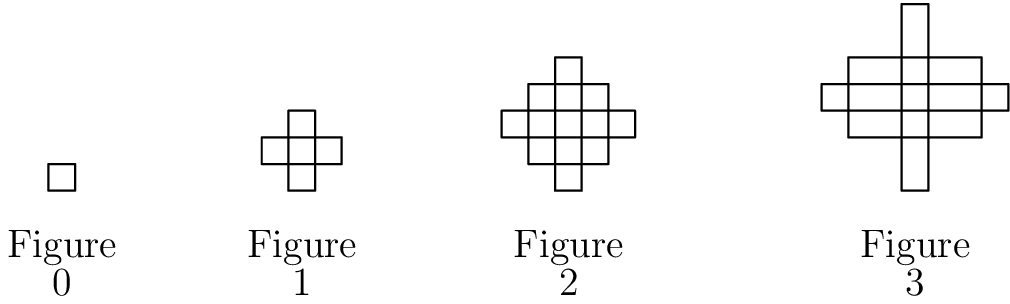
Figures , , , and consist of , , , and nonoverlapping unit squares, respectively. If the pattern were continued, how many nonoverlapping unit squares would there be in figure 100?
Show solution without answering
Key insight
Figure n has n squared plus (n+1) squared unit squares, so figure 100 has 100 squared plus 101 squared, which is 20201.
Solution
1. Look at the counts: . They grow by , and those jumps grow by each time. So the next jump is and figure has squares.
2. Try to spot a pattern using square numbers:
Figure seems to have squares.
3. Check it on figure , which we found has squares: . It matches.
4. The pattern also matches the picture. Read figure row by row: the rows have squares. The top part down to the longest row is the first odd numbers, which add to . The part below is the first odd numbers, which add to . For figure : and , total .
5. For figure , use (not , since the first figure is figure ):
The answer is .
Why this works
When the jumps between terms themselves grow by the same amount each time, the pattern is a "squared" formula, and small cases usually show it quickly. Always check a guessed formula on one more term before using it for , and watch whether the list starts at or .
Alternative approach
Count the picture directly. Each figure has one center square and four arms. In figure , each arm is a staircase with squares. For , one arm has squares, so the total is .
Concise solution
A shorter write-up, the way contest solutions are usually written. It may take a different route from the solution above.
The counts have first differences , which themselves go up by a constant . Constant second differences mean the count is a quadratic in the figure number .
Rather than solve for coefficients, match the data to a recognizable form:
So figure contains squares. As a check, the next difference should be , and .
For :
The answer is .
Review in the AoPS books
- Introduction to Algebra, Chapter 21: Sequences & Series (§21.1, §21.2, §21.3, §21.4)
- Introduction to Number Theory, Chapter 1: Integers: The Basics
- Prealgebra, Chapter 15: Problem-Solving Strategies (§15.1)
- Intermediate Algebra, Chapter 17: More Sequences and Series (§17.1, §17.2)
Similar problems
Problem © Mathematical Association of America (MAA), American Mathematics Competitions. Reproduced for non-commercial educational use. Solution and commentary are original to this site. Also appeared as 2000 12 #8.