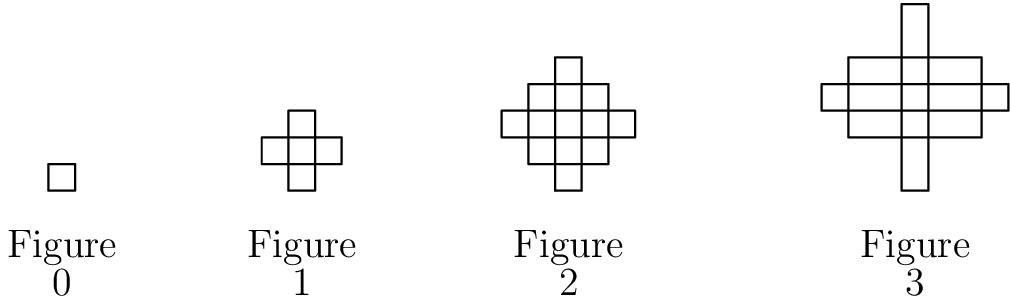
Figures , , , and consist of , , , and nonoverlapping unit squares, respectively. If the pattern were continued, how many nonoverlapping unit squares would there be in figure 100?
- A)
- B)
- C)
- D)
- E)
Answer
C
Key insight
Figure n has n^2 + (n+1)^2 squares (two rotated grids interleaved), so figure 100 has 100^2 + 101^2 = 20201.
Solution
The counts have first differences , which themselves go up by a constant . Constant second differences mean the count is a quadratic in the figure number .
Rather than solve for coefficients, match the data to a recognizable form:
So figure contains squares. As a check, the next difference should be , and .
For :
The answer is .
Why this works
When first differences form an arithmetic sequence, the terms are quadratic, and small cases usually reveal the closed form faster than solving three equations. Here the closed form has a picture behind it: the diamond of figure is an grid of squares interleaved with an grid, rotated . Always verify the guessed formula on one extra term before plugging in .
Alternative approach
Count directly: a central square plus four triangular arms, each holding squares. Figure has .
The trap
Off-by-one in the index: figures start at 0, so figure 100 is the 101st term; using 99^2 + 100^2 = 19801 gives (B).
Common mistakes
- Off-by-one in the index: figures start at 0, so figure 100 is the 101st term; using 99^2 + 100^2 = 19801 gives (B).
- Summing the differences and forgetting to add the initial .
- Extrapolating linearly from the first difference and getting something near .
Techniques
Compute small cases, spot the pattern, generalize