Statistics & Data
Mean, median, mode, range, data tables, charts, weighted averages
What you need to know
- Mean , so sum mean count. Almost every problem about a mean is really about the total. Example: five numbers with mean add up to .
- Median: put the numbers in order first. With an odd count, the median is the middle number. With an even count, it is the average of the two middle numbers. Example: sorts to , with median . And sorts to , with median .
- Mode: the value that appears most often. "Unique mode" means it appears strictly more often than every other value; a tie is not allowed. Example: has unique mode , but has no unique mode, since and tie.
- Range largest smallest. Example: has range .
- Combining two groups (a weighted average). If a group of people has mean and a group of people has mean , the mean of everyone is . Example: students averaging and averaging give .
How AMC 10 tests it
- Problems 1–8: find one statistic from another. The hard part is not mixing up the mean and the median.
- "After the next test my average will be ": change the averages into totals and subtract. Example: to go from an average of on tests to on , you need .
- Middle-of-the-paper problems where the mean, median, mode, and range are all given and you find the largest possible number in the list. Solve them with a bound plus a list that reaches it.
Standard approaches
- Rewrite every mean as a sum, and every median as a fact about a certain position in the sorted list.
- When numbers are added or removed, keep track of totals, not averages.
- For largest/smallest problems, first place the values that are forced (the median spot, the repeated mode). Then push the free values as far as they can go.
- Bound first, then build: show the larger answer is impossible, then write down a list that reaches the next one.
Worked example
A list of five positive integers has mean , median , and unique mode . What is the largest possible range of the list?
(A) (B) (C) (D) (E)
Solution. Write the list in order as .
Use the mean and median. The mean is , so the sum is . The median is the middle number, so .
Use the mode. The mode must appear at least twice. Only and can be , since , , are at most . So , and .
Make the range big. The range is , so we want as small as possible, which means as large as possible. Since appears exactly twice and is the unique mode, no other value may appear twice: and . As , this leaves , so .
Check that it works. The list has sum , median , and unique mode . Its range is . The answer is .
Pitfalls
- Giving the mean when the sum is asked, or the median when the mean is asked.
- Forgetting to sort before finding the median. Example: the middle of as written is , but the median is .
- Ignoring "unique" in "unique mode." Example: has sum and median , but ties with , so its range of is not allowed.
- Averaging group averages without weighting by group size. Example: above, is wrong; the true mean is .
Traps that recur
- Treating the median as 5.2 or one of the given numbers; with nine values the fifth must be an integer, so one of x, y, z has to sit in the middle. (2024 AMC 10B #15)
- Using five 8s to fill the bottom, which forces the other values up and yields 24; fewer 8s lets 1s in and gives a bigger maximum. (2014 AMC 10B #18)
- Ignoring that the mode must be unique, or forgetting the mean fixes the total at 64. (2002 AMC 10A #21)
- Assuming the mean is always the largest of the three statistics; when the median is x you must test all three orderings, and when the median is 4 you must discard solutions that leave the case's range. (2000 AMC 10 #23)
- 1.2016 AMC 10B #5
The mean age of Amanda's cousins is , and their median age is . What is the sum of the ages of Amanda's youngest and oldest cousins?
- A)
- B)
- C)
- D)
- E)
- 2.2014 AMC 10A #5
On an algebra quiz, of the students scored points, scored points, scored points, and the rest scored points. What is the difference between the mean and median score of the students' scores on this quiz?
- A)
- B)
- C)
- D)
- E)
- 3.2010 AMC 10A #1
Mary’s top book shelf holds five books with the following widths, in centimeters: , , , , and . What is the average book width, in centimeters?
- A)
- B)
- C)
- D)
- E)
- 4.2005 AMC 10A #6
The average (mean) of numbers is , and the average of other numbers is . What is the average of all numbers?
- A)
- B)
- C)
- D)
- E)
- 5.2001 AMC 10 #1
The median of the list is . What is the mean?
- A)
- B)
- C)
- D)
- E)
- 6.2024 AMC 10A #12
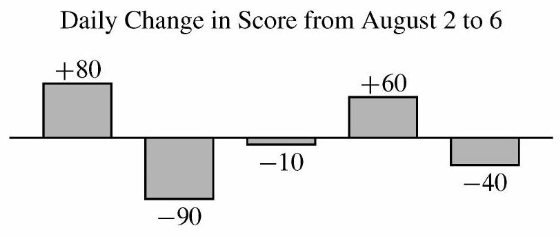
Zelda played the Adventures of Math game on August 1 and scored points. She continued to play daily over the next days. The bar chart below shows the daily change in her score compared to the day before. (For example, Zelda's score on August 2 was points.) What was Zelda's average score in points over the days?
- A)
- B)
- C)
- D)
- E)
- 7.2022 AMC 10A #8
A data set consists of (not distinct) positive integers: , , , , , and . The average (arithmetic mean) of the numbers equals a value in the data set. What is the sum of all possible values of ?
- A)
- B)
- C)
- D)
- E)
- 8.2021 AMC Fall 10A #10
A school has students and teachers. In the first period, each student is taking one class, and each teacher is teaching one class. The enrollments in the classes are and . Let be the average value obtained if a teacher is picked at random and the number of students in their class is noted. Let be the average value obtained if a student was picked at random and the number of students in their class, including the student, is noted. What is ?
- A)
- B)
- C)
- D)
- E)
- 9.2021 AMC 10B #6
Ms. Blackwell gives an exam to two classes. The mean of the scores of the students in the morning class is , and the afternoon class's mean score is . The ratio of the number of students in the morning class to the number of students in the afternoon class is . What is the mean of the scores of all the students?
- A)
- B)
- C)
- D)
- E)
- 10.2016 AMC 10A #7
The mean, median, and mode of the data values are all equal to . What is the value of ?
- A)
- B)
- C)
- D)
- E)
- 11.2013 AMC 10B #6
The average age of 33 fifth-graders is 11. The average age of 55 of their parents is 33. What is the average age of all of these parents and fifth-graders?
- A)
- B)
- C)
- D)
- E)
- 12.2001 AMC 10 #16
The mean of three numbers is more than the least of the numbers and less than the greatest. The median of the three numbers is . What is their sum?
- A)
- B)
- C)
- D)
- E)
- 13.2022 AMC 10B #10
Camila writes down five positive integers. The unique mode of these integers is greater than their median, and the median is greater than their arithmetic mean. What is the least possible value for the mode?
- A)
- B)
- C)
- D)
- E)
- 14.2021 AMC 10A #16
In the following list of numbers, the integer appears times in the list for . What is the median of the numbers in this list?
- A)
- B)
- C)
- D)
- E)
- 15.2021 AMC 10B #19
Suppose that is a finite set of positive integers. If the greatest integer in is removed from , then the average value (arithmetic mean) of the integers remaining is . If the least integer in is also removed, then the average value of the integers remaining is . If the greatest integer is then returned to the set, the average value of the integers rises to . The greatest integer in the original set is greater than the least integer in . What is the average value of all the integers in the set ?
- A)
- B)
- C)
- D)
- E)
- 16.2020 AMC 10A #11
What is the median of the following list of numbers
- A)
- B)
- C)
- D)
- E)
- 17.2019 AMC 10A #12
Melanie computes the mean , the median , and the modes of the values that are the dates in the months of . Thus her data consists of , , . . . , , , , and . Let be the median of the modes. Which of the following statements is true?
- A)
- B)
- C)
- D)
- E)
- 18.2019 AMC 10B #13
What is the sum of all real numbers for which the median of the numbers and is equal to the mean of those five numbers?
- A)
- B)
- C)
- D)
- E)
- 19.2018 AMC 10B #14
A list of positive integers has a unique mode, which occurs exactly times. What is the least number of distinct values that can occur in the list?
- A)
- B)
- C)
- D)
- E)
- 20.2012 AMC 10A #13
An iterative average of the numbers , , , , and is computed the following way. Arrange the five numbers in some order. Find the mean of the first two numbers, then find the mean of that with the third number, then the mean of that with the fourth number, and finally the mean of that with the fifth number. What is the difference between the largest and smallest possible values that can be obtained using this procedure?
- A)
- B)
- C)
- D)
- E)
- 21.2010 AMC 10B #17
Every high school in the city of Euclid sent a team of students to a math contest. Each participant in the contest received a different score. Andrea's score was the median among all students, and hers was the highest score on her team. Andrea's teammates Beth and Carla placed th and th, respectively. How many schools are in the city?
- A)
- B)
- C)
- D)
- E)
- 22.2005 AMC 10B #19
On a certain math exam, of the students got points, got points, got points, got points, and the rest got points. What is the difference between the mean and the median score on this exam?
- A)
- B)
- C)
- D)
- E)
- 23.2024 AMC 10B #15
A list of real numbers consists of , , , , , and , as well as , , and with . The range of the list is , and the mean and the median are both positive integers. How many ordered triples ( , , ) are possible?
- A)
- B)
- C)
- D)
- E)
- 24.2014 AMC 10B #18
A list of positive integers has a mean of , a median of , and a unique mode of . What is the largest possible value of an integer in the list?
- A)
- B)
- C)
- D)
- E)
- 25.2002 AMC 10A #21
The mean, median, unique mode, and range of a collection of eight integers are all equal to 8. The largest integer that can be an element of this collection is
- A)
- B)
- C)
- D)
- E)
- 26.2000 AMC 10 #23
When the mean, median, and mode of the list
are arranged in increasing order, they form a non-constant arithmetic progression. What is the sum of all possible real values of ?
- A)
- B)
- C)
- D)
- E)
Answers
| # | Answer | The idea it turns on |
|---|---|---|
| 1 | D | The mean makes the four ages add to 32; the median makes the middle two add to 10. The youngest and oldest are the rest: 22. |
| 2 | C | Pretend there are 100 students. The mean is 87. Counting up from the lowest score, the 50th student falls in the group that scored 90, so the median is 90. |
| 3 | D | Average means total divided by count. Add in easy groups: 6 + 10 = 16 and 1/2 + 2.5 + 1 = 4, so 20 / 5 = 4. |
| 4 | B | Turn each average into a total: 20 times 30 is 600 and 30 times 20 is 600. All 50 numbers add to 1200, so the average is 24. |
| 5 | E | The list is already in order, so the median is the middle (fifth) entry. Every entry is n plus a fixed number, so find n first, then average. |
| 6 | E | Turn the day-to-day changes into actual scores with a running total. Then average how far each score is above 1700 instead of adding six big numbers. |
| 7 | D | The mean is (20 + X)/6. Set it equal to each number in the list, including X itself, and keep the answers where X is a positive whole number. |
| 8 | B | t is the plain average, 20. For s, each student reports their own class size, so the big class counts 50 times: s = 33.5. |
| 9 | C | Only the 3 to 4 ratio matters, so pretend there are 3 morning and 4 afternoon students. Their scores total 532 over 7 students, which is 76. |
| 10 | D | Only the mean gives an equation: 540 + x must equal 7x, so x = 90. Then check that 90 is also the median and mode. |
| 11 | C | Turn each average back into a total: the kids' ages add to 363 and the parents' ages to 1815. Then divide the grand total by all 88 people. |
| 12 | D | Call the mean m. Then the numbers are m - 10, 5 and m + 15, and three numbers with mean m always add up to 3m. |
| 13 | D | The mode is above the median, so it fills the top two spots. The two smallest numbers must differ, which forces the mean to be at least 7. |
| 14 | C | The list has 20100 numbers, so the middle is at position 10050. The numbers 1 through n fill the first n(n+1)/2 spots; find which block holds that position. |
| 15 | D | Removing the greatest or the least leaves n − 1 numbers either way. Those two totals differ by 72 and the averages by 8, so n − 1 = 9. |
| 16 | C | With 4040 numbers the median is halfway between the 2020th and 2021st. The squares 1, 4, ..., 1936 (44 of them) squeeze in below, pushing the middle down by 44. |
| 17 | E | The modes are 1 to 28, so d = 14.5. The 183rd value is 16, so M = 16. Missing large dates pull the mean just below 16. |
| 18 | A | The median is 6, x, or 8, depending on where x falls. Solve median = mean in each case, then keep only answers that really fall in that case. |
| 19 | D | The mode is the only value that appears 10 times, so every other value appears at most 9 times. Fill the other 2008 spots using as few values as possible. |
| 20 | C | Each averaging step halves the weight of the earlier numbers, so the last number counts most. Put 5 last for the largest result and 1 last for the smallest. |
| 21 | B | Andrea is the one middle student, so the number of students is odd. She beat 37th place, and someone finished 64th; only 23 schools fit all three facts. |
| 22 | B | Pretend there are 20 students. The total of all scores divided by 20 gives the mean, 86. The middle students score 85, the median. |
| 23 | C | The mean makes x + y + z equal 11.2 or 20.2, and the median must be x, y or z. Then split by the smallest and largest numbers. |
| 24 | E | To make the biggest number large, make the other ten as small as possible. Using only three 8s lets two 1s into the low spots. |
| 25 | D | The mean makes the total 64, and the range makes the smallest number equal the largest minus 8. Push the largest up until the other conditions break. |
| 26 | E | The mode is always 2 and the mean is (25 + x)/7. The median is 2, x or 4, so check each case for three evenly spaced values. |
Problems © Mathematical Association of America (MAA), American Mathematics Competitions. Reproduced for non-commercial educational use. The topic note, tags and key insights are original to this site.